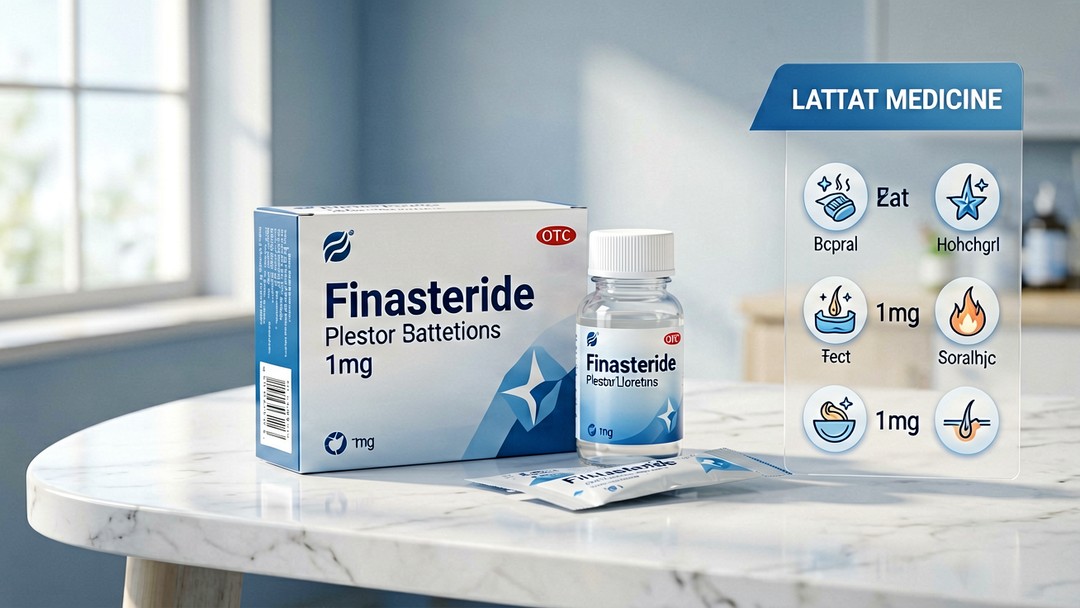
Finasteride, sold under the brand name Propecia, is a prescription medicine best known for treating hereditary hair loss (androgenetic alopecia) and an enlarged prostate (benign prostatic hyperplasia, or BPH). It works in a way that most people find surprising: rather than stimulating hair growth or reducing prostate size directly, it blocks the enzyme that converts testosterone into a more potent form called dihydrotestosterone (DHT). This single mechanism underlies both of its licensed uses. This guide explains how finasteride works, the supporting evidence, correct dosing, how it compares with alternatives, expected patient experience, side effects to watch for, and what treatment costs when you choose generic alternatives.
What Is Finasteride (Propecia)?
Finasteride is a 5-alpha-reductase inhibitor approved in two distinct settings. At 1 mg once daily (marketed as Propecia) it is used to treat male pattern hair loss; at 5 mg once daily (marketed as Proscar) it is used to treat the symptoms of an enlarged prostate. Both uses rest on the same pharmacology: blocking the type II isoform of the enzyme 5-alpha-reductase, which converts testosterone into dihydrotestosterone (DHT).
Because DHT is the androgen that drives both scalp hair follicle miniaturization in genetically susceptible men and prostate growth, reducing DHT slows hair loss and helps shrink the prostate. Finasteride does not ‘cure’ baldness. It slows or halts the progression of hair loss and, in many men, produces visible regrowth, but the effect is typically lost if treatment is stopped.
How It Works: Blocking DHT
Testosterone is converted to the far more potent androgen DHT by the enzyme 5-alpha-reductase. In the scalp, DHT binds to receptors in hair follicles and, in genetically susceptible men, progressively shortens the growth phase and shrinks (miniaturizes) the follicles, producing the characteristic thinning of male pattern baldness. In the prostate, DHT drives the overgrowth of prostate tissue that causes BPH symptoms.
Finasteride inhibits the type II form of 5-alpha-reductase, lowering serum DHT by roughly 65–70% over time. By reducing DHT, finasteride protects susceptible scalp follicles from continued miniaturization — preserving existing hair and often improving hair density — and it reduces prostate volume and improves urinary symptoms in men with BPH. Importantly, testosterone levels are generally maintained, which is why most men do not experience the effects one might associate with low testosterone.
Approved Uses and Indications
- Male pattern hair loss (1 mg/day): approved for the treatment of androgenetic alopecia in men; improves or stabilizes hair loss in the vertex (crown) and mid-scalp.
- Benign prostatic hyperplasia (5 mg/day): approved to reduce the risk of urinary retention, to reduce the need for prostate surgery, and to improve urinary flow and symptoms.
- Adjunct to finasteride rectal therapy (rural prostate, Dutasteride comparison): not applicable here — finasteride is oral only; do not confuse with topical forms.
A critical point: finasteride is not indicated for women, and it must not be handled by women who are or may become pregnant because of the risk of harm to a male fetus. It is also not effective for hair loss caused by anything other than androgenetic mechanisms.
Dosage and How to Take It
| Use | Typical Dose | Notes |
|---|---|---|
| Hair loss (androgenetic alopecia) | 1 mg once daily | Consistent daily use required; effects take months to appear. |
| BPH / enlarged prostate | 5 mg once daily | May take 3–6 months for maximal urinary benefit. |
| Duration of treatment | Long-term, continuous | Hair benefits reverse within 12 months if stopped. |
| Renal or hepatic impairment | No standard dose adjustment | Caution in liver disease; dose as directed by clinician. |
Finasteride is taken by mouth as one tablet daily, with or without food. For hair loss, consistent daily use is essential — the benefit depends on sustained DHT suppression, and if you stop, the hair that depended on treatment is typically lost again within 12 months. For prostate symptoms, improvement may take three to six months, so the drug is not a rapid fix for urinary urgency.
If you miss a dose, take it when you remember on the same day; if the day has passed, skip it. Do not double up. Men considering finasteride for hair loss should be patient, as noticeable results usually require at least three to six months of continuous use.
Clinical Evidence: What the Trials Show
The evidence for finasteride in hair loss is well established. In randomized placebo-controlled trials in men with androgenetic alopecia, finasteride 1 mg daily significantly improved hair counts and slowed hair loss compared with placebo. In landmark trials, a large majority of treated men showed either no further visible hair loss or measurable regrowth over one to two years, whereas placebo-treated men continued to lose hair. The benefit is most pronounced at the vertex and mid-scalp.
For BPH, long-term randomized trials show finasteride 5 mg reduces prostate volume, improves urinary symptoms and flow rate, and lowers the risk of acute urinary retention and the need for prostate surgery in men with enlarged prostates. In both settings, the benefit reflects sustained DHT reduction and takes time to become clinically apparent.
An important evidence-based caveat: finasteride works primarily for the DHT-driven, genetic form of hair loss. It does not regrow hair in men whose hair loss has a different cause, and it is not reliably effective in women with hair loss. Realistic expectations matter, and the drug is best assessed with at least a 6-month trial under a clinician’s guidance.
Finasteride vs Minoxidil vs Dutasteride
| Feature | Finasteride (1 mg) | Minoxidil (topical) | Dutasteride |
|---|---|---|---|
| Mechanism | Blocks DHT production | Stimulates follicles topically | Blocks DHT (both enzyme isoforms) |
| Route | Oral tablet | Topical foam/solution | Oral capsule (BPH; off-label hair) |
| Best for | Vertex/mid-scalp genetic loss | Vertex thinning, general shedding | BPH; sometimes off-label hair |
| Onset of visible effect | 3–6 months | 2–4 months | 3–6 months |
| Common side effects | <2% sexual side effects | Scalp irritation | Similar to finasteride |
| Blood marker | DHT reduction | None systemic | Stronger DHT suppression |
The practical comparison is often between finasteride and topical minoxidil. Finasteride tackles the root DHT-driven cause of genetic hair loss with a once-daily tablet, while minoxidil stimulates hair follicles directly and is used topically. Many men use them together for additive benefit, but finasteride is the only one of the two that addresses the hormonal driver. Dutasteride suppresses DHT more completely but is used mainly for BPH and carries a longer drug half-life; its use for hair loss is common but generally off-label in many regions.
Side Effects and Safety Profile
Finasteride is generally well tolerated, and the sexual side effects that generate the most publicity affect a small minority. In clinical trials, the most common reported adverse effects — decreased libido, erectile dysfunction, and reduced ejaculate volume — occurred in fewer than 2% to 3% of treated men and in most studies were not significantly more common than placebo. For most men these effects, when they occur, are mild and reversible on stopping the drug.
- Common: decreased libido, erectile dysfunction, decreased ejaculate volume (small minority).
- Persistence of sexual side effects: a small number of men report side effects that do not fully resolve after stopping; this is uncommon but a real consideration.
- Depression and mood changes: reported in a minority; monitor mood and discuss with a clinician.
- PSA effects: finasteride lowers PSA levels roughly by half, which must be considered when interpreting prostate cancer screenings.
- Pregnancy warning: women who are or may become pregnant must not handle crushed or broken tablets (fetal risk).
Men should not stop finasteride abruptly because of side effects without discussing alternatives with a clinician, and any persistent mood or sexual concerns should be raised directly. The small risk of high-grade prostate cancer was raised by one large prevention trial and remains an area of clinical discussion; finasteride reduces the overall risk of low-grade prostate cancer but may be associated with a slightly increased proportion of high-grade cases in some analyses — another reason prostate screening results must be interpreted in context.
Who Should Consider Finasteride?
Finasteride is most appropriate for men with confirmed androgenetic (male pattern) hair loss who want to slow or reverse it, and for men with an enlarged prostate causing urinary symptoms. It is not appropriate for women, and it is not a treatment for hair loss caused by thyroid disease, iron deficiency, chemotherapy, or other non-androgenetic causes. Men with active liver disease or unexplained urinary retention should discuss risks with their clinician before starting.
Realistic expectations are essential. Finasteride is a maintenance therapy — it must be taken continuously, and the hair benefit is typically lost within about a year of stopping. Before starting, discuss prostate cancer screening status, any history of male breast cancer, and the small risk of persistent sexual side effects with your clinician.
Generic Finasteride vs Brand Propecia: Cost Comparison
Propecia and Proscar patents have long expired, and finasteride is now available as a low-cost generic in many countries. Generic and brand products must meet the same bioequivalence and quality standards. For a medicine taken daily for years, generic pricing produces very large cumulative savings, and international generic supply from India is a major source of affordable licensed finasteride.
| Option | Typical 30-day supply (1 mg/day) | Notes |
|---|---|---|
| Indian generic finasteride 1 mg | $4–$9 | Extremely price-competitive; a 150-tablet pack is often under about $35. |
| US generic finasteride 1 mg | $12–$35 | Modest cash price; covered by many insurers. |
| US brand Propecia (cash price) | $60–$110 | Brand pricing is typically several times the generic. |
In India, finasteride is inexpensive and available from many licensed manufacturers — for example, a 150-tablet pack of 1 mg generic is commonly sold in the region of $25–$35, which is roughly a year-and-a-half of daily hair-maintenance dosing. If you are comparing affordable hair loss and prostate health treatment options from licensed generic suppliers, the savings from generic finasteride over brand therapy can be substantial over years of continuous use.
Frequently Asked Questions
How long does finasteride take to show results for hair loss?
Most men need three to six months of uninterrupted daily use before they can judge the effect. The drug’s main role is to stop further hair loss; measurable regrowth often takes longer, and the benefit is lost within about 12 months if you stop.
Is finasteride safe to use long term?
Finasteride is approved and used for years, with a favorable overall profile. The main long-term considerations are rare persistent sexual side effects, PSA interpretation, and the small discussion around prostate cancer risk, all of which should be weighed with your clinician.
Can women use finasteride for hair loss?
Finasteride is not approved for hair loss in women and must not be handled by women who are or may become pregnant because of the risk to a male fetus. Women should discuss appropriate hair-loss treatments with a clinician.
Why does finasteride lower PSA?
Finasteride reduces DHT-driven prostate activity and lowers serum PSA by roughly half. This means PSA values while on finasteride must be interpreted with that halving factored in, ideally with a clinician who knows the patient’s baseline.
Can I take finasteride and minoxidil together?
Yes — many men combine them because they work by different mechanisms. Finasteride addresses the DHT-driven cause of genetic hair loss, while topical minoxidil stimulates follicles. Combining them is common, but both should be used consistently and under guidance.
Medical Disclaimer
This article is for informational purposes only and does not replace professional medical advice, diagnosis, or treatment. Finasteride is a prescription medicine; always consult a licensed healthcare provider before starting, stopping, or changing your dose. It is not approved for use in women and must not be handled by women who are or may become pregnant. Prices vary by country, pharmacy, insurer, and over time, and the ranges shown are estimates that may differ from your local market. Obtain finasteride only through a legitimate prescription pathway.