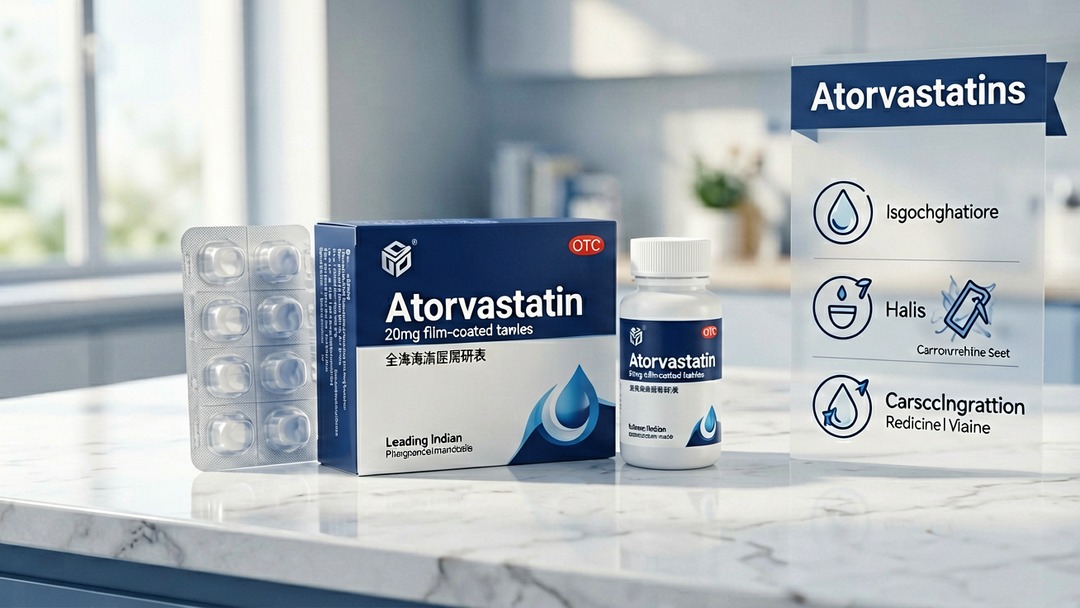
Atorvastatin is the most prescribed statin in the world, and for good reason: it is among the most potent cholesterol-lowering agents available and has one of the largest bodies of cardiovascular outcome evidence behind it. Usually taken as a once-daily 20 mg tablet, it reduces low-density lipoprotein (LDL) cholesterol by a substantial margin and lowers the risk of heart attack and stroke. This guide covers how atorvastatin works, who should take it, correct dosing, what the trials prove, how it compares with other statins, and what a month of generic therapy typically costs.
What Is Atorvastatin?
Atorvastatin is an oral HMG-CoA reductase inhibitor — a statin — in the same broad family as simvastatin, rosuvastatin, and pravastatin. It was developed and marketed under the brand name Lipitor by Pfizer and became the best-selling pharmaceutical product in history at the peak of its patent life. Today it is available as a wide range of generic equivalents that contain the identical active molecule.
In practice, atorvastatin is used to lower elevated LDL cholesterol and to reduce overall cardiovascular risk. It is prescribed both for primary prevention (people without prior events but with risk factors such as diabetes or hypertension) and secondary prevention (people who have already had a heart attack, stroke, or procedure). Because lowering LDL directly correlates with fewer events, atorvastatin’s role is fundamentally about protecting arteries over many years.
How Atorvastatin Works: Mechanism of Action
Cholesterol is manufactured in the liver through a pathway that depends on an enzyme called HMG-CoA reductase. Atorvastatin blocks this enzyme, so the liver produces less cholesterol internally. When intracellular cholesterol falls, the liver responds by pulling more LDL particles out of the bloodstream through upregulated LDL receptors, which is the primary way blood LDL levels drop.
Beyond simple LDL reduction, statins exert what clinicians call “pleiotropic” effects: they improve the stability of fatty plaques inside artery walls, reduce vascular inflammation, and may improve endothelial function. These actions help explain why the cardiovascular benefit of statins exceeds what LDL lowering alone would predict. Atorvastatin is metabolized by the liver enzyme CYP3A4, a detail that matters for several drug interactions covered below.
Approved Uses and Indications
- Hyperlipidemia and mixed dyslipidemia: to reduce elevated total and LDL cholesterol and triglycerides and raise HDL.
- Heterozygous familial hypercholesterolemia: inherited high LDL that often requires potent statin therapy.
- Primary prevention: in adults with multiple risk factors to reduce the risk of heart attack and stroke.
- Secondary prevention: after acute coronary syndrome, myocardial infarction, stroke, or revascularization.
- Type 2 diabetes patients: a high-risk group in whom statin therapy is broadly recommended.
Atorvastatin is not a weight-loss drug and does not replace diet and exercise. It is a long-term preventive medicine; skipping doses erodes the protective effect because LDL creeps back up within days to weeks.
Dosage and How to Take It
| Situation | Typical Regimen | Notes |
|---|---|---|
| Usual starting dose (most adults) | 10–20 mg once daily | Adjust after 2–4 weeks by LDL response. |
| Moderate-intensity target | 20–40 mg once daily | Lowers LDL by roughly 30–49%. |
| High-intensity target | 40–80 mg once daily | Lowers LDL by 50% or more. |
| Timing | Any time of day, once daily | Consistency matters more than clock time. |
| Renal or mild hepatic impairment | No routine adjustment | Avoid in active liver disease. |
Atorvastatin has a long half-life, so it can be taken at any time of day, unlike some shorter-acting statins that are best at night. If a dose is missed, take it when remembered unless it is nearly time for the next dose; never double up. Your clinician will recheck a lipid panel four to twelve weeks after starting or changing dose to confirm the LDL goal is being met.
Clinical Evidence: What the Trials Show
The cornerstone trial for atorvastatin is the ASCOT-LLA study, which enrolled over 10,000 hypertensive patients without prior heart disease but with at least three risk factors. Adding atorvastatin 10 mg daily cut fatal and non-fatal coronary events by about 36% and stroke by about 27% over roughly 3.3 years. The CARDS trial specifically in type 2 diabetes — a group without high baseline LDL — showed atorvastatin 10 mg reduced major cardiovascular events by about 37%, supporting statin use even when cholesterol appears only mildly elevated.
The TNT trial took this further: in patients with stable coronary disease, pushing atorvastatin from 10 mg to 80 mg lowered LDL further and reduced major cardiovascular events by about 22% compared with the lower dose, at a modest increase in reversible side effects. The SPARCL trial demonstrated a 16% reduction in subsequent stroke among patients with prior cerebrovascular disease. Collectively, these trials established atorvastatin as a high-confidence, high-intensity option across the prevention spectrum.
Atorvastatin vs Other Statins
| Feature | Atorvastatin 20 mg | Rosuvastatin 10 mg | Simvastatin 20 mg |
|---|---|---|---|
| LDL reduction (approx.) | ~40–45% | ~45–52% | ~35–40% |
| Dosing flexibility | Any time of day | Any time of day | Best at night |
| Metabolism pathway | CYP3A4 | Minimal CYP | CYP3A4 (more interactions) |
| Potency per mg | High | Highest | Moderate |
| Typical acquisition cost (generic) | Very low | Low to moderate | Very low |
For most patients, atorvastatin offers a strong balance of potency, dosing convenience, and cost. Rosuvastatin is slightly more potent per milligram and has fewer drug interactions, while simvastatin is inexpensive but carries more interaction limits at higher doses.
Generic Atorvastatin vs Brand Lipitor: Cost Comparison
Atorvastatin lost patent protection years ago, so generic manufacturers produce bioequivalent tablets that regulators require to match the brand in rate and extent of absorption. For patients paying out of pocket, the difference between a licensed generic and the original brand can be dramatic.
| Option | Typical 30-day supply (20 mg) | Typical 90-day supply |
|---|---|---|
| Indian generic atorvastatin 20 mg | $3–$8 | $8–$20 |
| US generic atorvastatin 20 mg | $5–$30 | $12–$75 |
| US brand-name Lipitor 20 mg (cash price) | $140–$380 | $380–$1,050 |
In India, atorvastatin 20 mg is produced by numerous WHO-GMP-certified manufacturers, and a month of therapy often costs only a few dollars. When reviewing licensed generic cardiovascular medication options, a verified supplier can reduce annual spending from hundreds of dollars on brand pricing to a small fraction of that. The molecule is identical; the main variable is taking the tablet consistently every day to keep LDL controlled.
Who Should Consider Atorvastatin?
Atorvastatin is appropriate if your clinician has identified elevated LDL cholesterol, established cardiovascular disease, or a combination of risk factors that places you at meaningful long-term risk. It is particularly valuable for patients with diabetes or prior heart events, where guidelines strongly endorse statin therapy. It is not a medicine to begin independently: the dose, intensity goal, and interaction screening require a prescriber. If brand pricing is unaffordable, ask about switching to a bioequivalent generic — the expected lipid-lowering effect is the same.
Side Effects and Safety Profile
The most discussed side effect is muscle-related symptoms — ache, stiffness, or weakness — which ranges from mild and common to, rarely, a serious condition called rhabdomyolysis that can damage the kidneys. Most people tolerate atorvastatin without trouble, and muscle symptoms are often dose-related and reversible after stopping. Routine liver enzyme monitoring is no longer recommended for everyone, but baseline and periodic checks are sensible, and the drug is avoided in active liver disease.
- Common: mild muscle aches, joint pain, slight nausea, diarrhea, or constipation.
- Less common: elevated liver enzymes, sleep disturbance, subtle memory complaints (usually reversible).
- Rare but serious: rhabdomyolysis, severe liver injury, allergic reactions.
- Contraindications: active liver disease, unexplained persistent transaminase elevation, pregnancy, and breastfeeding.
Stop the medicine and seek medical attention for dark urine, severe muscle pain, unexplained weakness, or yellowing of the skin or eyes. Report any new muscle symptoms to your clinician rather than simply stopping, so the cause can be assessed.
Drug Interactions to Discuss With Your Doctor
- Strong CYP3A4 inhibitors (clarithromycin, itraconazole, certain HIV protease inhibitors): raise atorvastatin levels and muscle-toxicity risk; dose limits apply.
- Grapefruit juice: can increase blood levels; avoid large quantities.
- Cyclosporine, gemfibrozil: markedly increase myopathy risk; combination often avoided.
- Warfarin: statins may mildly enhance anticoagulant effect; INR monitoring is prudent.
- Other lipid drugs (fibrates, niacin): additive muscle-risk when combined.
Frequently Asked Questions
What time of day should I take atorvastatin?
Any time of day works because atorvastatin has a long half-life. The most important factor is taking it at a consistent time so the habit sticks.
How much can atorvastatin lower my LDL?
A 20 mg dose typically lowers LDL cholesterol by roughly 40%, and higher intensities such as 40–80 mg can reduce it by 50% or more. Your target depends on your overall risk profile.
Is generic atorvastatin as effective as Lipitor?
Yes. Generic atorvastatin must meet the same bioequivalence standards as the brand, so LDL-lowering effect is equivalent. Differences are limited to tablet appearance, inactive ingredients, and price.
Do statins really cause memory problems?
Reports of memory issues exist, but large trials and regulatory reviews have not confirmed a causal deficit, and any effects are typically reversible after stopping. Discuss persistent cognitive symptoms with your clinician.
Can I drink grapefruit juice while taking atorvastatin?
Large amounts of grapefruit juice can raise atorvastatin blood levels and increase side-effect risk. Occasional small amounts are usually fine, but avoid daily large consumption.
How soon will I see cholesterol improvement?
LDL typically drops within two to four weeks of starting, and a repeat lipid panel is usually checked at four to twelve weeks to confirm the response and adjust the dose.
Medical Disclaimer
This article is for informational purposes only and does not replace professional medical advice, diagnosis, or treatment. Atorvastatin is a prescription medicine; always consult a licensed healthcare provider before starting, stopping, or changing your dose. Drug prices vary by country, pharmacy, insurance status, and over time; figures shown are approximate ranges, not quotes or guarantees. Never share prescription medicines, and never import medicines without verifying applicable regulations in your country.
References
- FDA. Lipitor (atorvastatin calcium) Prescribing Information.
- Sever PS, et al. ASCOT-LLA: prevention of coronary and stroke events with atorvastatin in hypertensive patients. Lancet. 2003;361(9364):1149-1158.
- Colhoun HM, et al. Primary prevention of cardiovascular disease with atorvastatin in type 2 diabetes (CARDS). Lancet. 2004;364(9435):685-696.
- LaRosa JC, et al. Intensive lipid lowering with atorvastatin in patients with stable coronary disease (TNT). N Engl J Med. 2005;352(14):1425-1435.
- Grundy SM, et al. 2018 AHA/ACC multi-society guideline on cholesterol management.
- Stroke Prevention by Aggressive Reduction in Cholesterol Levels (SPARCL) Investigators. N Engl J Med. 2006;355(6):549-559.