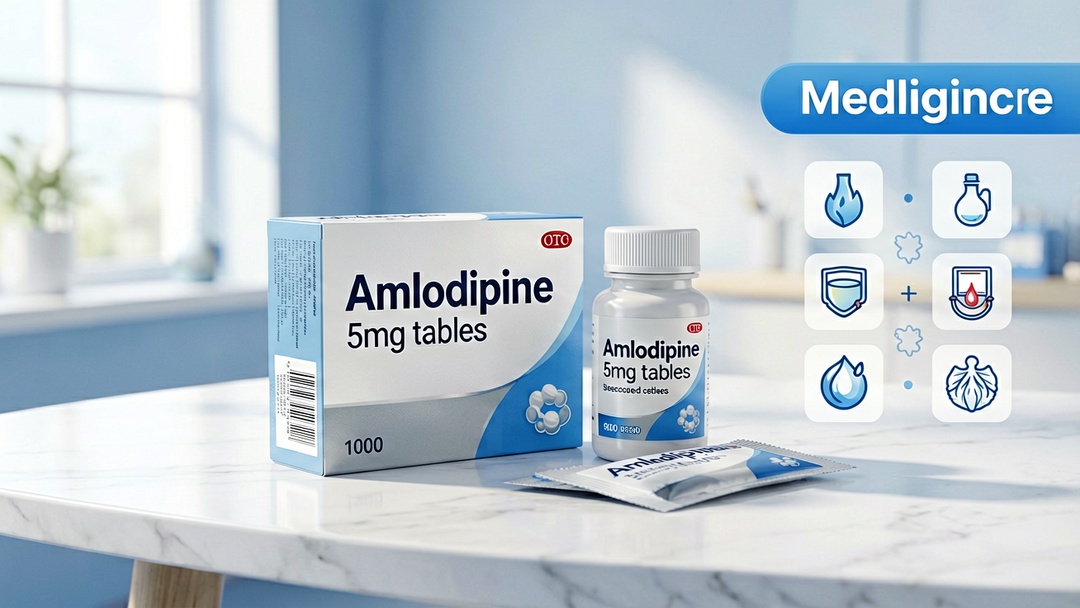
What Is Amlodipine?
Amlodipine (brand name Norvasc) is a calcium channel blocker (CCB) of the dihydropyridine class, primarily used for the treatment of hypertension and coronary artery disease. It is one of the most widely prescribed antihypertensive medications worldwide, with approximately 90 million prescriptions annually in the United States alone. Amlodipine works by relaxing the smooth muscles in arterial walls, reducing peripheral vascular resistance and lowering blood pressure. Its once-daily dosing regimen, excellent tolerability profile, and proven cardiovascular outcome benefits have made it a cornerstone of modern antihypertensive therapy across all major clinical guidelines.
How Amlodipine Works: Mechanism of Action
Amlodipine inhibits the influx of calcium ions through L-type calcium channels in vascular smooth muscle cells and cardiac muscle. By blocking calcium entry, amlodipine reduces the contractility of vascular smooth muscle, leading to vasodilation. This vasodilation decreases peripheral vascular resistance (afterload), which lowers blood pressure. Unlike some other calcium channel blockers, amlodipine has minimal negative inotropic effects at therapeutic doses, making it safe for use in patients with preserved left ventricular function. The drug also causes mild coronary vasodilation, improving myocardial oxygen supply in patients with coronary artery disease.
Amlodipine has a long half-life of approximately 30–50 hours, allowing for once-daily dosing. Steady-state concentrations are reached after 7–8 days of consistent dosing. Its gradual onset of action minimizes the risk of reflex tachycardia compared with shorter-acting dihydropyridine CCBs such as nifedipine. The extended half-life also means that missed doses have less impact on blood pressure control compared with shorter-acting agents.
Pharmacokinetics and Absorption
Amlodipine is well absorbed after oral administration with peak plasma concentrations occurring 6–12 hours after dosing. It is highly protein bound (approximately 93%) and undergoes extensive hepatic metabolism via CYP3A4 isoenzymes to inactive metabolites. The bioavailability is approximately 64–90%, and food intake does not significantly affect absorption. Due to its high volume of distribution (21 L/kg), amlodipine distributes widely into tissues. Renal elimination accounts for approximately 60% of metabolites, with 20–25% excreted in feces.
Approved Uses and Indications
| Condition | Indication Status | Evidence |
|---|---|---|
| Essential Hypertension (adults) | ✅ First-line (JNC 8, ACC/AHA, ESC/ESH) | Strong (multiple RCTs, meta-analyses) |
| Coronary Artery Disease (stable angina) | ✅ Recommended | Strong (ALLHAT, ASCOT, CAMELOT) |
| Chronic Stable Angina | ✅ Approved | Strong |
| Vasospastic (Prinzmetal) Angina | ✅ Approved | Moderate |
| Atherosclerosis (progression delay) | ✅ Indicated (with CAD evidence) | Moderate (PREVENT trial) |
Dosage and Administration
| Parameter | Details |
|---|---|
| Initial Dose (hypertension) | 2.5–5 mg once daily |
| Usual Maintenance Dose | 5–10 mg once daily |
| Maximum Dose | 10 mg daily |
| Elderly / Hepatic Impairment | 2.5 mg initial; titrate slowly |
| Dosing Frequency | Once daily (same time each day) |
| With/Without Food | Either; be consistent |
| Time to Peak Effect | 6–12 hours |
| Half-Life | 30–50 hours |
| Steady State | 7–8 days |
Common Side Effects of Amlodipine
The most common side effects of amlodipine are related to its vasodilatory mechanism. Peripheral edema (ankle swelling) occurs in up to 10–15% of patients, particularly at higher doses (10 mg). This is due to precapillary vasodilation and increased hydrostatic pressure, not fluid overload. Headache, dizziness, flushing, and palpitations may occur early in treatment but often resolve with continued use. Fatigue and nausea are reported in a small percentage of patients. Less common side effects include gingival hyperplasia, skin rash, and erectile dysfunction, though the latter is less common than with beta-blockers or diuretics.
Peripheral edema management: Strategies to reduce amlodipine-induced edema include dose reduction, splitting the dose, addition of an ACE inhibitor or ARB (which counteracts the precapillary pressure changes by dilating both arterioles and venules), or switching to a different CCB such as lacidipine or lercanidipine which may cause less edema.
Drug Interactions
Amlodipine is metabolized via CYP3A4 isoenzymes. Strong CYP3A4 inhibitors (clarithromycin, itraconazole, ketoconazole, ritonavir, grapefruit juice) can significantly increase amlodipine plasma concentrations, potentially leading to hypotension and edema. Strong CYP3A4 inducers (carbamazepine, phenytoin, rifampin, St. John’s wort) may reduce amlodipine efficacy. Simvastatin dose should not exceed 20 mg daily when co-administered with amlodipine due to increased risk of myopathy/rhabdomyolysis. Cyclosporine and tacrolimus levels may increase when co-administered with amlodipine, requiring therapeutic drug monitoring. There is no clinically significant interaction with warfarin.
Amlodipine vs Other Antihypertensives
| Comparison | Amlodipine | Other CCBs | ACE Inhibitors / ARBs |
|---|---|---|---|
| Blood pressure reduction | 10–15 mmHg (SBP) | Comparable | Comparable |
| Stroke reduction | ✅ Proven (ALLHAT) | ✅ Proven | ✅ Proven |
| Heart failure risk | Neutral | Some CCBs contraindicated | ✅ Improves outcomes |
| Edema | Common (10–15%) | Variable | Rare |
| Cough | Rare | Rare | 5–20% (ACE inhibitors) |
| Side effect profile | Generally well-tolerated | Variable | Generally well-tolerated |
India Generic Pricing
Generic amlodipine is widely available in India at very affordable prices. Below are approximate cost ranges for generic formulations. Actual prices may vary depending on the pharmacy, location, and quantity purchased.
| Medication | Strength | Indian Generic Price (per 10 tablets) | US Brand Price Comparison |
|---|---|---|---|
| Amlodipine (generic) | 2.5 mg | ₹5–₹8 ($0.06–$0.10) | $5–$15 (Norvasc®) |
| Amlodipine (generic) | 5 mg | ₹6–₹10 ($0.07–$0.12) | $5–$15 (Norvasc®) |
| Amlodipine (generic) | 10 mg | ₹8–₹12 ($0.10–$0.14) | $8–$20 (Norvasc®) |
| Amlodipine + Losartan combination | 5/50 mg | ₹18–₹25 ($0.22–$0.30) | $30–$60 (brand combinations) |
Note: Prices are approximate ranges and subject to change. For current pricing and availability, browse our generic blood pressure medications.
Frequently Asked Questions
Important Safety Information and Contraindications
Amlodipine is contraindicated in patients with cardiogenic shock, unstable hemodynamics after acute myocardial infarction, or severe aortic stenosis. Use with caution in patients with heart failure with reduced ejection fraction (HFrEF), as CCBs without heart rate-slowing properties have been associated with worse outcomes in some heart failure populations, although amlodipine has a neutral effect on mortality in HFrEF patients based on the PRAISE trials. Blood pressure should be monitored regularly, especially during dose titration. Patients should be advised not to discontinue therapy abruptly and to report any persistent or severe ankle swelling, shortness of breath, or irregular heartbeat to their healthcare provider.
Clinical Evidence: Major Trials
The landmark ALLHAT trial (2002), involving over 33,000 patients across 623 centers in North America, compared amlodipine, lisinopril, and chlorthalidone as first-line antihypertensive therapy. Amlodipine was non-inferior to chlorthalidone for the primary composite outcome of fatal coronary heart disease or nonfatal myocardial infarction. The ASCOT trial (2005), which randomized over 19,000 patients, showed that an amlodipine-based regimen (with perindopril added as needed) significantly reduced cardiovascular events (HR 0.84, p=0.001) and new-onset diabetes (HR 0.70, p=0.0001) compared to an atenolol-based regimen. The CAMELOT trial (2004) demonstrated that amlodipine slowed the progression of coronary atherosclerosis compared to placebo in patients with angiographically documented coronary artery disease.
Special Populations
Elderly: Amlodipine is effective and well-tolerated in elderly patients. Initial doses of 2.5 mg daily are recommended with gradual titration. Pregnancy: Amlodipine is classified as FDA Pregnancy Category C. It should be used during pregnancy only if the potential benefit justifies the potential risk to the fetus. Renal impairment: No dose adjustment is required for patients with renal impairment, as amlodipine is primarily metabolized hepatically. Hepatic impairment: Dose reduction is recommended due to reduced clearance. Pediatric use: Amlodipine is approved for use in children aged 6 years and older for hypertension.
Conclusion
Amlodipine remains one of the most effective and well-tolerated first-line treatments for hypertension. Its once-daily dosing, gradual onset, long half-life, and proven cardiovascular outcome benefits make it a preferred agent in most major hypertension guidelines (ACC/AHA, ESC/ESH, JNC 8). Affordable generic versions are widely available, particularly from Indian manufacturers, making it accessible for long-term blood pressure management. When prescribed appropriately and monitored regularly, amlodipine offers excellent blood pressure control with a favorable risk-benefit profile for the vast majority of patients with hypertension.
Medical Disclaimer: This article is for informational purposes only. It does not replace professional medical advice, diagnosis, or treatment. Always consult your healthcare provider before starting or changing any medication. Price ranges are approximate and may vary by pharmacy and location.
References
- ALLHAT Officers and Coordinators. “Major outcomes in high-risk hypertensive patients randomized to angiotensin-converting enzyme inhibitor or calcium channel blocker vs diuretic.” JAMA. 2002;288(23):2981-2997.
- Dahlöf B, et al. (ASCOT). “Prevention of cardiovascular events with an antihypertensive regimen of amlodipine adding perindopril as required versus atenolol adding bendroflumethiazide as required.” Lancet. 2005;366(9489):895-906.
- Whelton PK, et al. “2017 ACC/AHA Guideline for the Prevention, Detection, Evaluation, and Management of High Blood Pressure in Adults.” J Am Coll Cardiol. 2018;71(19):e127-e248.
- Williams B, et al. “2018 ESC/ESH Guidelines for the management of arterial hypertension.” Eur Heart J. 2018;39(33):3021-3104.
- Nissen SE, et al. (CAMELOT). “Effect of antihypertensive agents on cardiovascular events in patients with coronary disease and normal blood pressure.” JAMA. 2004;292(18):2217-2225.
- Pitt B, et al. (PREVENT). “Long-term effect of amlodipine on atherosclerosis progression and cardiovascular events.” Circulation. 2000;102(13):1503-1510.
- Packer M, et al. (PRAISE). “Effect of amlodipine on morbidity and mortality in severe chronic heart failure.” N Engl J Med. 1996;335(15):1107-1114.
- FDA Prescribing Information: Norvasc (amlodipine besylate). Pfizer. Revised 2020.
- UpToDate. “Amlodipine: Drug information.” Accessed July 2026.
- Epstein BJ, et al. “Management of calcium channel blocker-induced peripheral edema.” J Clin Hypertens. 2015;17(8):639-646.