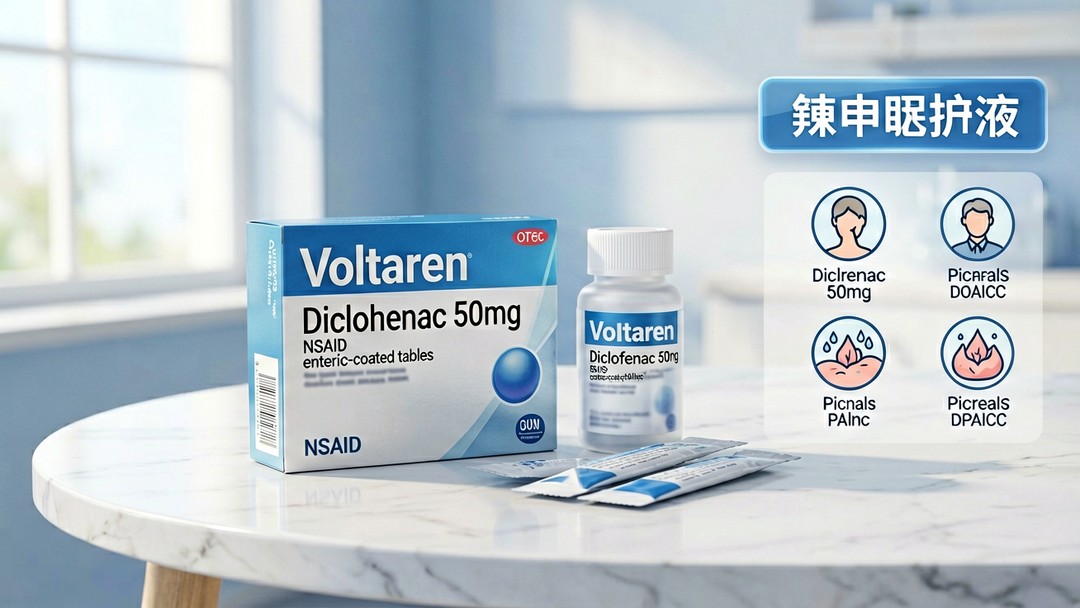
Diclofenac — sold worldwide as Voltaren and produced as a low-cost generic by dozens of manufacturers — is one of the most widely prescribed nonsteroidal anti-inflammatory drugs (NSAIDs) on earth. It is available as oral tablets, topical gel, eye drops, suppositories, and injections, making it one of the most versatile pain medications in clinical use. This guide covers how diclofenac works, correct dosing for tablets and gel, its cardiovascular and gastrointestinal safety profile, and what generic diclofenac from India costs versus brand-name Voltaren.
What Is Diclofenac?
Diclofenac is a non-selective COX inhibitor developed by Ciba-Geigy (now Novartis) and introduced in 1973. It is available in two main chemical forms — diclofenac sodium and diclofenac potassium — with slightly different absorption profiles. The potassium salt absorbs faster (useful for acute pain), while the sodium salt is commonly formulated as enteric-coated or extended-release tablets for osteoarthritis and rheumatoid arthritis. Indian manufacturers including Cipla, Sun Pharma, Zydus, Torrent, and Ipca produce WHO-GMP certified generic diclofenac at very low cost, and topical Voltaren gel (diclofenac sodium 1%) became available over the counter in the US in 2020.
How Diclofenac Works: Mechanism of Action
Diclofenac blocks the cyclooxygenase (COX) enzymes COX-1 and COX-2, which convert arachidonic acid into prostaglandins:
- COX-2 inhibition reduces inflammation — prostaglandins drive the redness, swelling, heat, and pain of inflammation; blocking COX-2 lowers these mediators at the site of injury or arthritis.
- COX-1 inhibition reduces protective prostaglandins — this is also the source of gastrointestinal side effects, because COX-1 prostaglandins protect the stomach lining.
- Potency advantage — diclofenac is roughly 2–3 times more potent on a milligram basis than ibuprofen or naproxen, so effective doses are lower.
In head-to-head trials, diclofenac is consistently among the most effective NSAIDs for osteoarthritis pain and is comparable to COX-2 inhibitors (celecoxib, etoricoxib) for efficacy while costing far less.
Forms and Formulations
- Oral tablets — diclofenac sodium 25/50/75 mg (enteric-coated, EC) and diclofenac potassium 50 mg (immediate release, used for acute pain and dysmenorrhea).
- Extended-release (SR/ER) — 75/100 mg tablets for once-daily or twice-daily dosing in chronic arthritis.
- Topical gel 1% — OTC Voltaren Arthritis Pain gel in the US; effective for osteoarthritis of the knees and hands with minimal systemic exposure.
- Topical solution 1.5–2% — Pennsaid-type drops for knee osteoarthritis.
- Eye drops 0.1% — for post-operative ocular inflammation and allergic conjunctivitis.
- Suppositories and injections — used when oral dosing is not possible.
Approved Uses of Diclofenac
- Osteoarthritis — oral or topical; the most common indication worldwide.
- Rheumatoid arthritis — symptom control in combination with disease-modifying therapy.
- Ankylosing spondylitis — first-line symptom relief for inflammatory back pain.
- Acute musculoskeletal pain — sprains, strains, back pain, sports injuries.
- Primary dysmenorrhea — diclofenac potassium is specifically approved for menstrual pain.
- Acute gout flares — an alternative when colchicine or steroids are contraindicated.
- Post-operative pain — short-term use in surgical settings.
Dosage and Administration
| Formulation | Typical Dose | Frequency | Maximum |
|---|---|---|---|
| Diclofenac sodium EC 50 mg | 50 mg | 2–3 times daily | 150 mg/day (short term) |
| Diclofenac potassium 50 mg | 50 mg | Every 8 hours | 150 mg/day |
| Extended-release 75/100 mg | 75–100 mg | Once daily (or 75 mg twice daily) | 150 mg/day |
| Topical gel 1% | 2–4 g per joint | 4 times daily | 32 g/day total |
| Eye drops 0.1% | 1 drop | 4 times daily | Per ophthalmologist |
Key administration points:
- Enteric-coated tablets should be swallowed whole with food or milk to reduce stomach irritation.
- Use the lowest effective dose for the shortest possible duration — the cardiovascular and GI risks are dose- and duration-dependent.
- Topical gel is not a substitute for oral therapy in widespread inflammatory disease, but it dramatically lowers systemic side-effect risk for localized osteoarthritis.
- Do not combine oral diclofenac with other NSAIDs (including aspirin at anti-inflammatory doses) without medical advice.
Diclofenac vs Other NSAIDs
| Drug | Potency (relative) | GI Risk | CV Risk | Best For |
|---|---|---|---|---|
| Diclofenac | High | Moderate | Moderate (higher than naproxen) | Arthritis, acute pain, dysmenorrhea |
| Ibuprofen | Medium | Lower at OTC doses | Moderate | General pain, fever, OTC use |
| Naproxen | Medium-high | Moderate | Lower (favourable CV profile) | Chronic arthritis, gout |
| Celecoxib (COX-2) | High | Lower | Moderate | GI-risk patients |
| Meloxicam | Medium | Moderate | Moderate | Once-daily convenience |
| Ketorolac | Very high | High | High | Short-term severe pain only |
Diclofenac sits at the potent end of the NSAID spectrum: it is more effective than ibuprofen or naproxen for many patients with osteoarthritis, but it carries a cardiovascular signal that prescribers weigh carefully — the reason naproxen is often preferred in patients with known heart disease.
Diclofenac Generic Pricing: India vs US
Prices vary by pharmacy, region, and time; all figures below are approximate ±10% ranges, not exact quotes.
| Product | Indian Generic (typical range) | US Generic | US Brand (Voltaren) |
|---|---|---|---|
| Diclofenac sodium 50 mg, 20 tablets | $2–$5 | $12–$27 | $90–$170 |
| Diclofenac potassium 50 mg, 20 tablets | $2.50–$6 | $14–$30 | $95–$180 |
| Diclofenac SR 100 mg, 20 tablets | $4–$9 | $25–$55 | — |
| Diclofenac gel 1%, 100 g tube | $4–$9 | $25–$45 (OTC) | $30–$55 (OTC) |
A one-month course of diclofenac 50 mg twice daily (60 tablets) costs roughly $6–$15 with Indian generics versus $35–$80 for US generics and $270–$510 for the brand at US retail. The topical gel — the most popular self-care format — costs a fraction of the US OTC price when sourced as Indian generic gel. Bioequivalent Indian generics deliver the same molecule and the same clinical effect. Browse more cost-effective options in the pharmaceuticals category on 984online.com.
Safety Profile and Side Effects
Common side effects include:
- Gastrointestinal upset — dyspepsia, nausea, abdominal pain; risk of ulcers and bleeding increases with dose, duration, and age.
- Fluid retention and edema — especially in patients with heart or kidney disease.
- Elevated liver enzymes — diclofenac can raise transaminases; rare cases of severe liver injury have been reported.
- Headache and dizziness — usually transient.
Serious risks to know:
- Cardiovascular — all NSAIDs except aspirin carry an increased risk of heart attack and stroke; diclofenac’s signal is toward the higher end, comparable to selective COX-2 inhibitors. The FDA requires a boxed warning on all prescription NSAIDs.
- Gastrointestinal bleeding — the classic NSAID risk; highest in patients over 65, those with prior ulcer disease, and those on anticoagulants or steroids.
- Kidney injury — NSAIDs reduce renal blood flow; avoid in significant chronic kidney disease and dehydration.
- Liver injury — diclofenac is among the NSAIDs most associated with hepatotoxicity; avoid in active liver disease.
When NOT to use diclofenac: known NSAID allergy (including aspirin-exacerbated respiratory disease), active GI bleeding or ulcer, severe heart failure, significant renal impairment, and the third trimester of pregnancy (can cause premature closure of the fetal ductus arteriosus).
Drug Interactions
- Anticoagulants (warfarin, apixaban, rivaroxaban) — increased bleeding risk.
- ACE inhibitors / ARBs and diuretics — reduced antihypertensive effect and increased kidney injury risk (the infamous “triple whammy”).
- Corticosteroids and SSRIs — additive GI bleeding risk.
- Lithium and methotrexate — NSAIDs raise their blood levels.
- Aspirin — may reduce aspirin’s cardioprotective effect when taken together.
Frequently Asked Questions
1. Is Voltaren gel as effective as diclofenac tablets?
For localized osteoarthritis (knees, hands), topical diclofenac 1% gel is roughly comparable to oral diclofenac for pain relief, with far lower systemic absorption — meaning fewer stomach and cardiovascular side effects. For widespread inflammation or severe pain, oral dosing is usually needed.
2. How long can I take diclofenac?
For acute pain, use the shortest course that works — typically 3–7 days. For chronic arthritis, the lowest effective dose should be used, with periodic reassessment by your doctor, because both GI and cardiovascular risks rise with duration.
3. Can I take diclofenac with paracetamol (acetaminophen)?
Yes. Combining diclofenac with paracetamol is common and generally safe — the two work by different mechanisms. Do not exceed the paracetamol daily maximum (3,000–4,000 mg depending on the label) and never combine diclofenac with other NSAIDs.
4. Is diclofenac safe for the heart?
No NSAID is risk-free for the heart, and diclofenac carries a moderate cardiovascular signal. Patients with known heart disease are usually steered toward naproxen or non-NSAID options. Use the lowest effective dose for the shortest time and discuss cardiovascular risk with your doctor.
5. Can I use diclofenac gel while taking oral diclofenac?
Avoid stacking them — combined use increases total systemic exposure and side-effect risk without much added benefit. Choose one route; if oral therapy is insufficient, talk to your doctor about escalation rather than layering formulations.
Bottom Line
Diclofenac is one of the most effective NSAIDs available, with a versatility matched by few pain medications — oral, topical, ocular, and injectable forms cover everything from knee osteoarthritis to menstrual cramps. Its risks (GI bleeding, cardiovascular events, liver and kidney strain) are real but manageable with low-dose, short-duration use and careful patient selection. For most people, bioequivalent Indian generic diclofenac delivers the same pain relief as Voltaren at a small fraction of the cost.
References
- Voltaren (diclofenac sodium) FDA prescribing information, US FDA.
- Bally M, et al. Risk of acute myocardial infarction with NSAIDs in real-world use: Bayesian network meta-analysis. BMJ. 2017;357:j1909.
- Bhala N, et al. Vascular and upper gastrointestinal effects of NSAIDs (Coxib and traditional NSAID Trialists’ Collaboration). Lancet. 2013;382:769-779.
- US FDA. NSAIDs: Drug Safety Communication — prescription NSAIDs and cardiovascular risk (2015).
- Altman RD, et al. Topical diclofenac for osteoarthritis pain. Drugs. 2015.
- Cochrane Database Syst Rev. Topical NSAIDs for chronic musculoskeletal pain in adults.
- UpToDate. Diclofenac: Drug information. Wolters Kluwer.
Medical Disclaimer
This article is for informational purposes only and is not a substitute for professional medical advice, diagnosis, or treatment. Always consult a qualified healthcare provider before starting, changing, or stopping any medication. Prices shown are approximate ranges and may vary by pharmacy, region, and over time.