
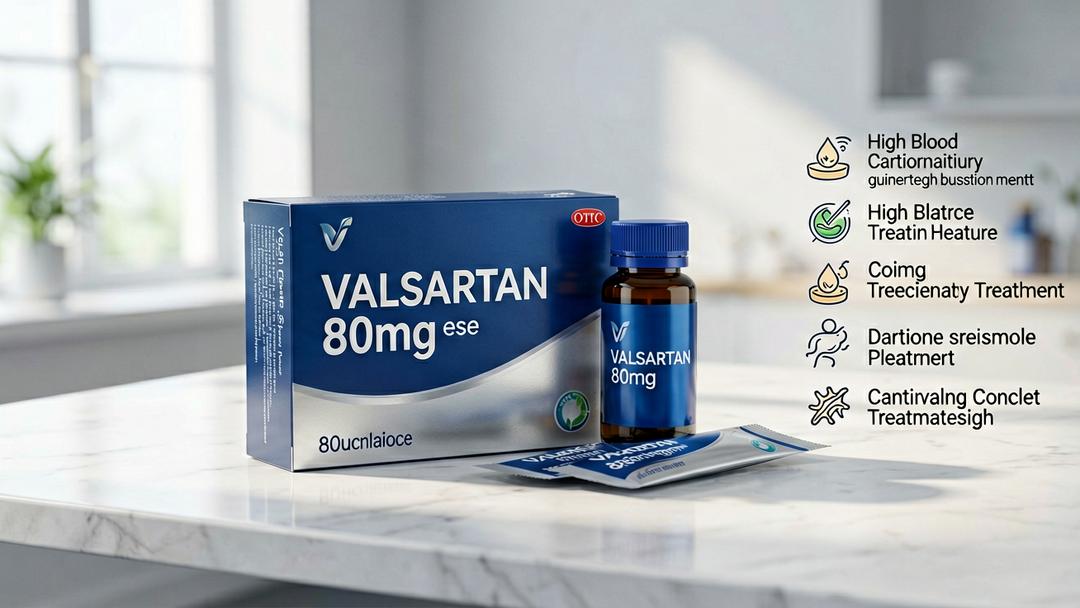
What Is Valsartan (Diovan)?
Valsartan is an angiotensin II receptor blocker (ARB) used to treat high blood pressure (hypertension), heart failure, and to improve survival after a heart attack. Marketed under the brand name Diovan (Novartis), it belongs to the same therapeutic family as losartan and irbesartan but is distinguished by its once-daily dosing, a long half-life of roughly 6 hours, and a favourable tolerability profile that avoids the dry cough commonly seen with ACE inhibitors.
First approved by the U.S. FDA in 1996, valsartan has since become a backbone therapy in global cardiovascular guidelines. Unlike ACE inhibitors, which block the enzyme that produces angiotensin II, valsartan selectively blocks the AT1 receptor that angiotensin II would otherwise bind to — producing smooth-muscle relaxation, reduced aldosterone, and lower blood pressure without affecting bradykinin metabolism.
How Valsartan Works (Mechanism of Action)
Angiotensin II is a powerful vasoconstrictor. When it binds to AT1 receptors on blood vessels, the adrenal glands, and the kidneys, it raises blood pressure through three main routes:
- Vasoconstriction – narrowing of arteries and arterioles.
- Aldosterone release – causing sodium and water retention.
- Sympathetic activation – increasing heart rate and contractility.
Valsartan occupies the AT1 receptor and prevents angiotensin II from exerting these effects. The result is vasodilation, reduced blood volume, and decreased cardiac workload. Because it does not influence bradykinin, the bothersome dry cough seen in up to 1 in 10 ACE-inhibitor users is rare with valsartan.
Approved Uses & Indications
- Hypertension: Lowering blood pressure in adults and children 6 years and older, alone or with other agents.
- Heart failure: Reducing hospitalization and improving functional capacity in NYHA class II–IV patients intolerant of ACE inhibitors.
- Post-myocardial infarction: Improving survival when started 12 hours to 10 days after a heart attack complicated by left-ventricular dysfunction.
Dosage Guidelines
| Condition | Typical Starting Dose | Usual Maintenance | Maximum |
|---|---|---|---|
| Hypertension (adult) | 80 mg × 1/day | 160–320 mg/day | 320 mg/day |
| Heart failure | 40 mg × 2/day | 80–160 mg × 2/day | 320 mg/day |
| Post-MI | 20 mg × 2/day | Titrate to 160 mg × 2/day | 320 mg/day |
| Hypertension (child ≥6 yr) | Based on weight; ~1.3 mg/kg | Up to 2.7 mg/kg/day | 40 mg/day |
Doses can be taken with or without food. Tablets should be swallowed whole with water; the capsule form (Diovan) may be opened and sprinkled on applesauce for patients who cannot swallow pills.
Valsartan vs. Other Blood Pressure Medications
| Feature | Valsartan (ARB) | Lisinopril (ACE-I) | Amlodipine (CCB) |
|---|---|---|---|
| Drug class | Angiotensin receptor blocker | ACE inhibitor | Calcium channel blocker |
| Dry cough risk | Low | High (~10%) | Low |
| Angioedema risk | Low | Moderate | Low |
| Ankle swelling | No | No | Yes (~5%) |
| Once-daily dosing | Yes | Yes | Yes |
| Typical cost (generic) | Low | Low | Low |
Cost & Generic Pricing (India & U.S.)
Generic valsartan is widely manufactured in India under WHO-GMP–certified facilities and is available at a fraction of the original brand price. In the United States, brand-name Diovan has largely been replaced by lower-cost generic versions.
| Product | Typical U.S. Brand Price (30 tabs) | Generic / India-Sourced Price (30 tabs) |
|---|---|---|
| Diovan 80 mg (brand) | $180–$260 | — |
| Valsartan 80 mg (generic, U.S.) | $9–$36 | — |
| Valsartan 80 mg (India generic) | — | $3–$9 |
| Valsartan 160 mg (India generic) | — | $5–$12 |
Prices vary by pharmacy, strength, and quantity; the ranges above reflect typical retail and international-supply estimates and are not exact quotes. For related cardiovascular treatments, see our complete Lisinopril blood-pressure guide.
Side Effects & Safety
Most people tolerate valsartan well. The most frequently reported effects include:
- Dizziness or lightheadedness (especially when starting or increasing dose)
- Fatigue
- Viral-like symptoms (in HF trials)
- Abdominal pain, cough (less common than with ACE inhibitors)
Serious but rare: angioedema, kidney impairment, hyperkalemia (high potassium), and liver enzyme changes. Patients with bilateral renal artery stenosis or on potassium-sparing diuretics / supplements need close monitoring.
Who Should Avoid Valsartan
- Pregnancy (Category D in 2nd/3rd trimester – can cause fetal injury)
- History of angioedema related to ARBs/ACE inhibitors
- Severe liver impairment (Child-Pugh C) with candesartan-class caution
- Concomitant use with aliskiren in diabetic patients
Special Populations
- Elderly: Higher risk of dizziness and kidney effects; lower starting doses and slower titration are standard.
- Chronic kidney disease: Monitor creatinine and potassium, as ARBs can transiently raise serum creatinine.
- Pregnancy: Contraindicated in the 2nd–3rd trimester (fetal renal toxicity, oligohydramnios, skull defects); use alternative agents in women planning pregnancy.
- Black patients: Monotherapy with ARBs/ACE inhibitors shows less BP response than in other groups; combination with a thiazide or CCB is often needed.
- Diabetes: ARBs are kidney-protective in diabetic nephropathy and do not cause the cough that complicates ACE-inhibitor use.
Drug Interactions
- NSAIDs (ibuprofen, naproxen) – reduce antihypertensive effect, raise kidney risk
- Potassium supplements / spironolactone – increase hyperkalemia risk
- Lithium – reduced clearance, toxicity risk
- Other antihypertensives – additive blood-pressure lowering
- Diuretics (especially loop / thiazide) – may cause first-dose hypotension when started together
Clinical Evidence & Guidelines
Valsartan’s role is supported by large randomized trials. The VALIANT trial enrolled over 14,700 patients after myocardial infarction with left-ventricular dysfunction and found valsartan non-inferior to captopril for reducing death from cardiovascular causes. The Val-HeFT study showed that adding valsartan to standard heart-failure therapy reduced hospitalization for heart failure. Major guidelines — including those from the American College of Cardiology / American Heart Association and the European Society of Cardiology — list ARBs such as valsartan as recommended alternatives when ACE inhibitors are not tolerated, and as foundational therapy in heart failure with reduced ejection fraction.
For uncomplicated hypertension, valsartan lowers systolic blood pressure by an average of 10–15 mmHg and diastolic by 6–10 mmHg at standard doses, with the effect plateauing rather than continuing to fall at higher doses — an important safety feature that limits symptomatic hypotension.
Monitoring During Therapy
- Blood pressure – checked at start and after each dose change (home monitoring recommended).
- Kidney function & potassium – baseline and within 1–2 weeks of initiation, especially with diuretics or CKD.
- Symptom review – dizziness, fatigue, or swelling should prompt dose review.
- Pregnancy test – for women of childbearing potential before starting an ARB.
Patient Experience & Practical Tips
Most patients starting valsartan notice little immediately — it is not a “feel it working” drug. The goal is silent, long-term protection of the heart, kidneys, and brain. Practical advice:
- Take it the same time daily — morning routines (with coffee or breakfast) improve adherence.
- Stand up slowly — orthostatic dizziness is more likely in the first weeks or after dose increases.
- Stay hydrated — volume depletion worsens lightheadedness and kidney stress, especially in heat or illness.
- Track readings — a simple home blood-pressure log helps your clinician fine-tune the dose.
- Storage — keep tablets at room temperature, away from moisture and direct light; do not use past the expiry date.
Because valsartan is frequently combined with a diuretic or other antihypertensive, patients on multiple pills should use a pill organizer and reconcile medications at every appointment to avoid duplication or missed doses.
Decision Guide: Is Valsartan Right for You?
- Choose Valsartan if you had an ACE-inhibitor cough or need ARB-class therapy for heart failure / post-MI protection.
- Choose an ACE inhibitor if you have heart failure with reduced ejection fraction where ACE-I evidence is strongest.
- Add a thiazide or CCB if monotherapy does not reach goal blood pressure.
Frequently Asked Questions
Can I take valsartan at night?
Yes. Studies on “bedtime dosing” of antihypertensives suggest night-time intake may improve overnight blood-pressure control, but consistency matters most. Pick a time you will remember daily.
What should I do if I miss a dose?
Take it as soon as you remember unless it is near the next scheduled dose. Do not double up. Missing occasional doses can cause rebound blood-pressure elevation.
Is generic valsartan as effective as Diovan?
FDA-approved generics must be bioequivalent to the brand — same active ingredient, dose, and therapeutic effect. Quality concerns in 2018 (NDMA impurity recalls) led to tighter testing; current supplies meet specification.
How long until blood pressure drops?
Peak effect occurs within 2–4 hours of a dose, but meaningful 24-hour control and full benefit builds over 2–4 weeks of consistent use.
Can valsartan be combined with a diuretic?
Yes. Fixed-dose combinations with hydrochlorothiazide (e.g., valsartan/HCTZ) are common and improve adherence when monotherapy is insufficient.
Medical Disclaimer
This article is for informational purposes only and does not constitute medical advice. Blood-pressure therapy must be individualized by a licensed healthcare provider. Prices shown are estimated ranges that vary by pharmacy, country, strength, and quantity, and are not a guarantee of any specific cost. Always consult your physician or pharmacist before starting, stopping, or changing any medication, and review the full prescribing information for your product.