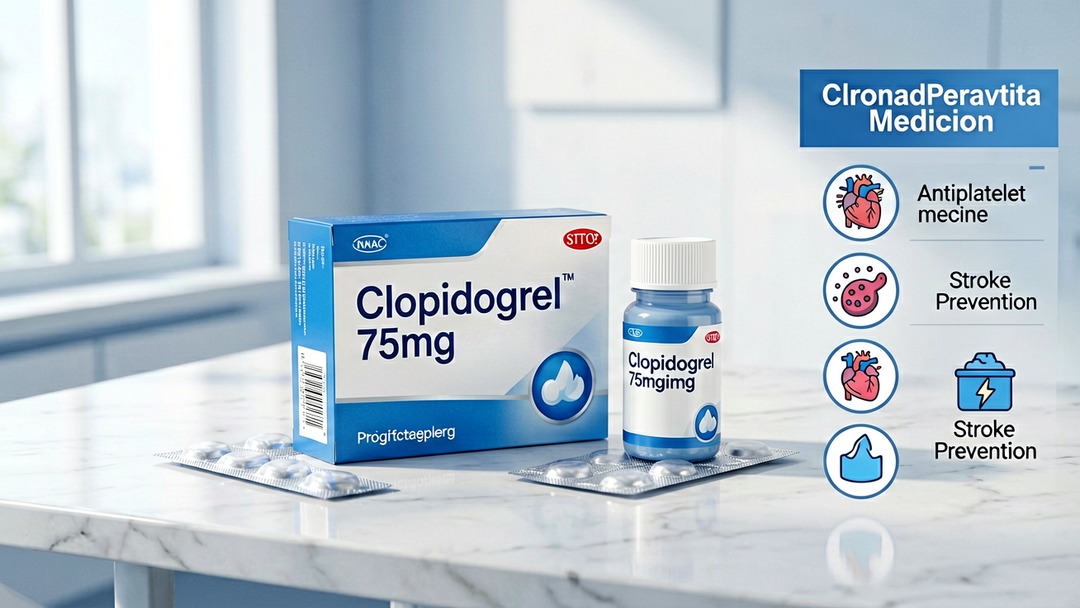
Clopidogrel is one of the most widely prescribed antiplatelet medicines in the world. Taken once daily as a 75 mg tablet, it helps prevent blood clots from forming in arteries, reducing the risk of heart attack, stroke, and stent-related complications. This guide explains how clopidogrel works, who needs it, correct dosing, what the research shows, how it compares with aspirin, and what a 30-day supply costs when you choose generic alternatives.
What Is Clopidogrel?
Clopidogrel is an oral antiplatelet agent belonging to the thienopyridine class. It was originally developed and marketed under the brand name Plavix by Sanofi and Bristol-Myers Squibb, and it became one of the best-selling medicines in history. The drug is a prodrug: it has little activity on its own, but after absorption it is converted by liver enzymes (mainly CYP2C19) into an active metabolite that blocks platelet activation.
In medical practice, clopidogrel is used in two main settings. First, as a single antiplatelet therapy in patients who have already had a heart attack, stroke, or peripheral artery disease (secondary prevention). Second, in combination with aspirin — a strategy called dual antiplatelet therapy (DAPT) — after a coronary stent is placed or after a recent acute coronary syndrome event. Because platelets are central to clot formation in arteries, keeping them “quiet” is the cornerstone of cardiovascular prevention.
How Clopidogrel Works: Mechanism of Action
Platelets are tiny blood cells that clump together to stop bleeding. In diseased arteries, however, platelet clumping can form a thrombus that blocks blood flow, causing heart attacks and ischemic strokes. Clopidogrel works by irreversibly binding to the P2Y12 adenosine diphosphate (ADP) receptor on the platelet surface. When ADP can no longer activate this receptor, the platelet cannot change shape, release granules, or cross-link with fibrinogen, so aggregation is suppressed for the rest of that platelet’s lifespan — about 7 to 10 days.
This irreversible, receptor-level blockade is what distinguishes clopidogrel from aspirin, which only inhibits the COX-1 enzyme pathway. Combining the two blocks parallel activation routes, which is why DAPT is more potent than either drug alone in the weeks after stent placement. Onset of effect is relatively rapid: with a 300 mg loading dose, meaningful platelet inhibition occurs within hours, whereas maintenance therapy with 75 mg daily builds up full effect over 3 to 7 days.
Approved Uses and Indications
- Recent myocardial infarction (heart attack): reduces the rate of recurrent heart attacks, strokes, and vascular death.
- Recent ischemic stroke: secondary prevention in patients with a history of atherothrombotic stroke or transient ischemic attack (TIA).
- Established peripheral artery disease (PAD): lowers the risk of cardiovascular events and improves limb outcomes in symptomatic PAD.
- Acute coronary syndrome (ACS): used with aspirin, including in patients managed medically or with PCI (stenting).
- After coronary stenting: standard DAPT with aspirin for a defined period, typically 6 to 12 months depending on stent type and bleeding risk.
- Atrial fibrillation patients unable to take anticoagulants: sometimes used as an alternative in specific guideline-directed scenarios.
Clopidogrel is not a painkiller and does not dissolve existing clots. It is a preventive medicine, and skipping doses meaningfully increases the risk of stent thrombosis or recurrent events.
Dosage and How to Take It
| Situation | Typical Regimen | Notes |
|---|---|---|
| Maintenance (most patients) | 75 mg once daily | Take at the same time daily; may be taken with or without food. |
| Loading dose before PCI | 300 mg (sometimes 600 mg) | Given by a cardiologist before stent procedures. |
| Acute coronary syndrome | 300 mg load, then 75 mg daily | Combined with aspirin 75–100 mg daily as DAPT. |
| After stent placement | 75 mg daily + aspirin | Duration usually 6–12 months; follow your cardiologist’s plan. |
| Renal or hepatic impairment | No routine dose adjustment | Caution in severe liver disease; discuss with your doctor. |
If a dose is missed within 12 hours of the usual time, take it immediately and resume the normal schedule. If more than 12 hours have passed, skip the missed dose — never double up, because that raises bleeding risk without adding benefit. Do not stop clopidogrel on your own; abrupt discontinuation after stenting can trigger stent thrombosis within days.
Clinical Evidence: What the Trials Show
Clopidogrel’s evidence base is unusually strong. The landmark CAPRIE trial (1996, Lancet) randomized more than 19,000 patients with recent heart attack, stroke, or PAD to clopidogrel 75 mg or aspirin 325 mg. Over a mean follow-up of about 2 years, clopidogrel reduced the combined endpoint of ischemic stroke, myocardial infarction, or vascular death by roughly 9% relative to aspirin, with a comparable safety profile. The benefit was most pronounced in the peripheral artery disease subgroup.
The CURE trial (2001, New England Journal of Medicine) studied more than 12,500 patients with acute coronary syndrome without ST-elevation. Adding clopidogrel to aspirin for a median of 9 months cut the combined endpoint of cardiovascular death, heart attack, or stroke by about 20%, at the cost of a modest increase in major bleeding. Sub-analyses, including the PCI-CURE and CREDO studies, confirmed the value of clopidogrel in patients undergoing stenting.
Two clinical caveats matter in practice. First, CYP2C19 poor metabolizers (roughly 2–5% of the population in most ethnic groups, higher in some Asian populations) convert clopidogrel less efficiently; guidelines suggest considering alternative P2Y12 inhibitors in such patients. Second, proton pump inhibitors such as omeprazole can reduce clopidogrel activation, so pantoprazole is often preferred when gastric protection is needed during DAPT.
Clopidogrel vs Aspirin vs Newer Antiplatelets
| Feature | Clopidogrel 75 mg | Aspirin 75–100 mg | Ticagrelor 90 mg twice daily |
|---|---|---|---|
| Mechanism | Irreversible P2Y12 blockade | Irreversible COX-1 inhibition | Reversible P2Y12 blockade |
| Onset of full effect | 3–7 days (maintenance) | Minutes to hours | 1–2 hours |
| Gastrointestinal side effects | Low | Higher (dyspepsia, ulcers) | Low, but dyspnea reported |
| Bleeding risk | Moderate | Moderate | Higher in ACS trials |
| Typical daily cost (generic) | Very low | Very low | Higher |
| Best evidence setting | Stable disease, stroke, PAD, DAPT | Primary prevention (selected), acute MI | ACS with or without stenting |
For most patients who need long-term secondary prevention and cannot tolerate aspirin, clopidogrel is the guideline-preferred alternative. For high-risk ACS patients, ticagrelor or prasugrel offer faster, more consistent inhibition, though at higher acquisition cost and, in some trials, higher bleeding rates.
Side Effects and Safety Profile
The most important risk of clopidogrel is bleeding, because that is its intended effect taken to excess. Common bleeding events include easy bruising, nosebleeds, bleeding gums, and prolonged bleeding from small cuts. More serious events — gastrointestinal bleeding, intracranial hemorrhage — are uncommon but must be taken seriously. Seek medical attention promptly for black or bloody stools, blood in urine, coughing blood, unusual headaches, or weakness on one side of the body.
- Common: bruising, minor epistaxis, diarrhea, abdominal pain, dyspepsia, rash.
- Uncommon but serious: major GI bleeding, intracranial hemorrhage, thrombotic thrombocytopenic purpura (very rare), hypersensitivity reactions.
- Allergic warning: patients allergic to clopidogrel or any thienopyridine should not take it.
Before surgery, including dental procedures, tell your clinician you take clopidogrel; it is usually held for 5 to 7 days before major operations. Do not combine clopidogrel with other blood thinners (warfarin, rivaroxaban, apixaban) unless explicitly prescribed, and avoid over-the-counter NSAIDs such as ibuprofen, which add bleeding risk.
Drug Interactions to Discuss With Your Doctor
- Omeprazole / esomeprazole: reduce clopidogrel activation; pantoprazole is generally preferred.
- Strong CYP2C19 inhibitors: can blunt the antiplatelet effect.
- Anticoagulants and NSAIDs: additive bleeding risk.
- SSRIs/SNRIs (e.g., escitalopram, duloxetine): may increase bleeding risk when combined with antiplatelets.
- St. John’s wort: may alter drug levels; avoid.
Generic Clopidogrel vs Brand Plavix: Cost Comparison
Clopidogrel is one of the most cost-effective cardiovascular medicines available today because its patent expired years ago. The active ingredient is identical between the brand and generic versions, and regulatory agencies require bioequivalence testing before generic approval. For patients paying out of pocket, the price difference is dramatic.
| Option | Typical 30-day supply (30 × 75 mg) | Typical 90-day supply |
|---|---|---|
| Indian generic clopidogrel 75 mg | $5–$7 | $14–$20 |
| US generic clopidogrel 75 mg | $8–$30 | $20–$75 |
| US brand Plavix 75 mg (cash price) | $340–$460 | $900–$1,300 |
In India, clopidogrel 75 mg is widely produced by dozens of WHO-GMP-certified manufacturers, and a month of therapy typically costs a fraction of a dollar per tablet. If you are looking for affordable cardiovascular medication options, comparing licensed generic suppliers can cut annual out-of-pocket spending from thousands of dollars to under $100. Many patients find that switching to a quality-checked generic source saves them 90% or more compared with brand pricing in high-income countries.
Who Should Consider Clopidogrel?
Clopidogrel is appropriate for you if you have had a heart attack, ischemic stroke, TIA, or symptomatic PAD, or if a stent has recently been placed and your cardiologist prescribed DAPT. It is also the standard alternative when aspirin causes gastrointestinal intolerance or allergy. It is not a medication to start on your own: the decision requires a clinician because the balance between clot prevention and bleeding risk is individual. If you cannot afford brand-name therapy, discuss switching to a bioequivalent generic with your doctor — the clinical outcome should be the same.
Frequently Asked Questions
Can I take clopidogrel instead of aspirin?
Yes, for secondary prevention clopidogrel 75 mg once daily is a guideline-endorsed alternative to aspirin, and it causes less gastrointestinal irritation. However, some patients need both as dual antiplatelet therapy — never switch on your own.
How long do I need to take clopidogrel after a stent?
For most patients with a drug-eluting stent, guidelines recommend 6 to 12 months of DAPT with aspirin plus clopidogrel. Your cardiologist may extend or shorten this based on bleeding risk, stent type, and the reason for stenting.
Is generic clopidogrel as effective as Plavix?
Yes. Generic clopidogrel must meet the same bioequivalence standards as the brand, and real-world studies have not shown meaningful differences in outcomes. The main variable is taking it consistently every day.
What should I do if I miss a dose?
If it has been less than 12 hours, take the missed dose right away. If more than 12 hours have passed, skip it and continue with your next scheduled dose. Never take two tablets at once.
Can I take clopidogrel with food?
Yes, food does not meaningfully change absorption of the 75 mg maintenance dose, so take it with or without meals at a consistent time each day.
Does clopidogrel cause stomach bleeding?
Clopidogrel increases bleeding risk compared with no treatment, including gastrointestinal bleeding, though less than aspirin in most comparisons. Report dark stools, vomiting blood, or severe abdominal pain to a doctor immediately.
Medical Disclaimer
This article is for informational purposes only and does not replace professional medical advice, diagnosis, or treatment. Clopidogrel is a prescription medicine; always consult a licensed healthcare provider before starting, stopping, or changing your dose. Drug prices vary by country, pharmacy, insurance status, and over time; figures shown are approximate ranges, not quotes or guarantees. Never share prescription medicines, and never import medicines without verifying applicable regulations in your country.
References
- FDA. Plavix (clopidogrel bisulfate) Prescribing Information.
- CAPRIE Steering Committee. A randomised, blinded, trial of clopidogrel versus aspirin in patients at risk of ischaemic events (CAPRIE). Lancet. 1996;348(9038):1329-1339.
- Yusuf S, et al. Effects of clopidogrel in addition to aspirin in patients with acute coronary syndromes without ST-segment elevation (CURE). N Engl J Med. 2001;345(7):494-502.
- Levine GN, et al. 2016 ACC/AHA guideline focused update on duration of dual antiplatelet therapy. Circulation. 2016;134(10):e123-e155.
- Dean L. Clopidogrel therapy and CYP2C19 genotype. Medical Genetics Summaries. NCBI Bookshelf.