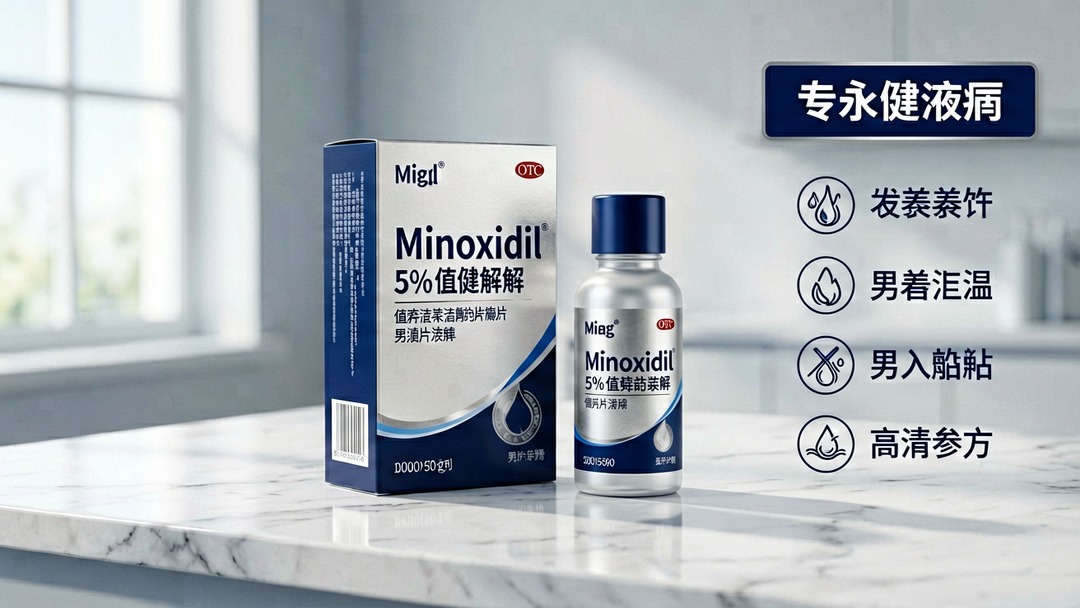
What Is Minoxidil (Rogaine)?
Minoxidil is a topical vasodilator originally developed as an oral blood-pressure medication, repurposed decades ago as a topical treatment for hereditary hair loss after researchers noticed that it promoted hair regrowth. Sold under the brand name Rogaine and now widely available as generic minoxidil, it is one of the only two treatments with strong evidence for androgenetic alopecia — the other being the oral 5-alpha reductase inhibitor finasteride. Unlike finasteride, which blocks hormone-driven hair loss, minoxidil acts locally on the scalp and can be used by both men and women, which makes it a first-line option for anyone looking for a well-tolerated, non-hormonal way to slow thinning and encourage regrowth.
Minoxidil is available as a 2% solution, a 5% solution, a 5% foam and increasingly as low-dose oral tablets. The 5% strength is the most studied and is generally considered more effective than 2% for men with androgenetic alopecia, while 2% remains a common starting point for women. This guide focuses on what the evidence actually shows: how minoxidil works, how long it takes, how much it costs including price differences between brand and non-brand versions, and how it compares with finasteride for long-term management of pattern hair loss.
How Minoxidil Works: Mechanism of Action
The precise mechanism of minoxidil is not fully understood, but the leading explanation centers on its action as a potassium channel opener. By opening ATP-sensitive potassium channels in vascular smooth muscle, minoxidil causes vasodilation — increasing blood flow to the scalp and, importantly, to the dermal papilla at the base of each hair follicle. The hair follicle is a highly vascular structure, and improved microcirculation, combined with direct effects on follicular cells, is thought to prolong the anagen (growth) phase of the hair cycle and enlarge miniaturized follicles that have begun to shrink under the influence of male hormones.
In practical terms, minoxidil does not block the hormones that cause pattern hair loss — that is finasteride’s job. Instead, it works downstream to stimulate and thicken the follicle. This mechanism has two clinically important consequences. First, minoxidil can help anyone whose follicles are still viable, regardless of hormone status, which is why it is effective in both sexes and in some non-hormonal forms of hair loss. Second, the effect is continuous — minoxidil must be used consistently, and hair that regrows is lost within a few months if treatment stops.
Approved Uses of Minoxidil
- Male pattern hair loss (androgenetic alopecia): the main approved use, primarily on the crown (vertex), with evidence of benefit on the mid-scalp as well.
- Female pattern hair loss: approved at 2% strength and increasingly used off-label at 5% once daily; effective for diffuse thinning on the crown.
- Post-chemotherapy hair regrowth: sometimes used to speed regrowth, though evidence is mixed.
- Alopecia areata (patchy hair loss): occasional adjunct use with mixed results; not a primary guideline treatment.
- Hair transplant maintenance: used to preserve native hair around transplanted grafts.
Minoxidil does not regrow hair on completely bald, smooth scalp where follicles have been dormant for years, and it does not prevent hair loss from scarring. It works best in early-to-moderate thinning among younger men and women. Combination with on-label or off-label therapies can improve outcomes but should be guided by a clinician.
Dosage and How to Use Minoxidil
Standard instructions for topical minoxidil are to apply 1 mL to the affected areas of a dry scalp twice daily for 5% solution and 2% used once or twice daily, then massage the scalp. The foam formulation dries quickly and is preferred by many for its cosmetic convenience and lower residue. The dose for oral low-dose minoxidil, when used off-label, is typically 0.25 mg to 1 mg per day, significantly lower than the original hypertension doses.
Consistency is critical. Minoxidil should be applied to a dry scalp and should not be washed off for at least 4 hours. Because the hair cycle works slowly, visible results on the crown usually begin around the 3- to 4-month mark, with maximum effect between 6 and 12 months. It is common for some users to notice a temporary shedding phase in the first 2 to 8 weeks as minoxidil pushes synchronized hair into new growth — this is a sign the drug is working and generally resolves on its own. Do not stop, because the regrown hair will be lost again after 1 to 3 months of non-use.
Minoxidil Comparison: 2% vs 5% vs Finasteride
| Factor | Minoxidil 2% | Minoxidil 5% | Finasteride (oral) |
|---|---|---|---|
| Form available | Solution | Solution / foam | Oral tablet 1 mg |
| Best evidence | Women’s hair loss | Men’s crown hair loss | Hormonal pattern loss |
| Typical visible results | ~4–6 months | ~3–4 months | ~3–6 months |
| Mechanism | Follicle stimulant | Follicle stimulant | Blocks DHT conversion |
| Sex use | Men & women | Mostly men | Men only |
| Common side effects | Scalp irritation | Scalp irritation, itchiness | Reduced libido (rare) |
| Typical monthly cost | Low–moderate | Moderate | Moderate–higher |
Both strengths of topical minoxidil are considered safe and effective. Clinical trials have generally shown 5% minoxidil to deliver noticeably better results than 2% in men with hereditary hair loss, at the price of slightly more scalp irritation. For many, choosing 5% makes sense as a first try in men, whereas 2% remained a common option for women who want maximum tolerability. Finasteride works through a completely different pathway and is the usual combination partner — many clinicians recommend using a 5-alpha reductase inhibitor and minoxidil together for the best long-term outcome.
Clinical Evidence: What the Research Shows
The regulatory evidence for topically applied minoxidil is strong. Early dose-response clinical studies established that 5% minoxidil solution improves hair growth results measured by hair weight and hair count compared with 2% and placebo over 48 weeks of use. A meta-analysis of randomized controlled trials confirmed the superior efficacy of 5% topical foam versus solution in reducing uncomfortable side effects such as itching and dryness while maintaining comparable effects on hair.
Long-term follow-up studies underscore that the growth continues only with ongoing use and that stopping minoxidil leads to a loss of the new hair within 3 to 6 months, returning the scalp toward its pre-treatment appearance. In head-to-head trials with add-on therapy, twice-daily application and consistent use were the strongest predictors of good outcome. For men with early-to-moderate pattern hair loss, the evidence supports minoxidil as an effective, well-characterized option that preserves density and slows progression when used correctly as long as it is continued.
Minoxidil Generic Pricing: Cost Comparison
Topical minoxidil pricing is an area where generic alternatives deliver significant savings. The brand-name Rogaine foam typically retails for approximately $30–$50 per month in US pharmacies, while US generic 5% foam and solution often fall in the $20–$40 range. The comparable Indian generic minoxidil, available in 5% solution and foam from multiple manufacturers, is typically priced in the $8–$20 range per month at typical pack sizes — and because it is the same molecule, it has similar effects to the brand product.
Two concrete examples illustrate the spread. A 5% combination-strength medication set from a leading Indian manufacturer is commonly listed around $65–$80 per set once, while a single 60 mL bottle of 5% topical solution from another producer typically runs $10–$16 — the exact, real-world price depends on the pack size, the strength and the pharmacy. For a therapy that must be bought continuously for months, the difference between a $35 US-commercial product and a comparable $15 generic for the same percentage can total over a year of savings to several hundred dollars.
This price comparison matters because hair regrowth requires sustained, long-term use, so the monthly cost is arguably more important than the per-pack price. Choosing cost-effective treatment options — whether a verified international generic or a discount coupon — lets you stay compliant with the habit long enough to see results. As prices vary by seller and promo, treat the figures above as ±10% guides rather than warranties.
Safety Profile and Side Effects
Topically, minoxidil is generally well tolerated, and most side effects are limited to the application site: scalp irritation, itching, redness, dryness, flaking and a temporary shedding phase that begins after 2 to 8 weeks. Rarely, there is a danger of irritation or allergic contact dermatitis with the base. Systemic absorption is negligible with normal topical use, but people with a history of cardiovascular disease or who use very large amounts should be cautious, because minoxidil is a potent vasodilator and can rarely cause of the low blood pressure or balance.
If a person notices facial hair growth, sudden and severe itching, or any scalp skin that breaks, this usually means the drug or the carrier vehicle doesn’t suit you — reducing the frequency or switching to the foam vehicle (which contains fewer irritants) often cuts it. In the case of the oral form, the most relevant side effects are fluid retention, and at very low doses the body reaction is usually well-tolerated, but it is only prescribed for hair loss therapy when it is done by a specialist. It must never be used by pregnant women or by anyone using medications without first checking with a doctor.
Who Should Consider Minoxidil — Decision Guide
- Men with early-to-moderate hereditary crown hair loss: 5% solution or foam of a form is a first-line, well-documented choice.
- Women with female pattern hair loss: 2% daily or 5% used at a lower frequency works to slow thinning.
- People who want a non-hormonal approach: minoxidil is the main therapy without effects on libido or hormone levels.
- In combination with finasteride: for better density on the crown, many clinicians use both as an option.
- Not appropriate when: the scalp is smooth and without hair for many years (follicles dormant), in sudden weather on the full scalp with another cause, or with a known allergy to the ingredients.
Frequently Asked Questions
1. When will I see results from minoxidil?
Most users see visible crown or scalp density change around the 3-to-4-month mark of consistent twice-daily use, with maximum effect at 6 to 12 months. Some notice a temporary shedding phase during the first few weeks — this is a signal of the treatment starting and usually passes.
2. Is minoxidil better than finasteride?
They work differently, so “better” depends on your situation. Minoxidil is a non-hormonal stimulant for both men and women; finasteride blocks DHT. Many clinicians recommend both together for the most robust result. In men who want to avoid hormonal side effects, minoxidil alone is reasonable.
3. Will my hair fall out if I stop minoxidil?
Yes. The regrown hair depends on continued use. Within a few months of stopping, hair density returns to what it was before, and the thinning resumes. Minoxidil is a maintenance treatment that works as long as you use it.
4. Is generic minoxidil as effective as the brand?
For topical minoxidil, generic versions use the same active molecule, and clinical equivalence trials support comparable function at significant savings. Choosing a reliable formulation and staying consistent matters more than the label.
5. Can women use 5% minoxidil?
Yes, though 5% can cause irritation and regular use of 5% has been shown effective. Many doctors start with 2% daily and switch to 5% if the strength is handled well, or use 5% once per day. Minoxidil should be avoided in pregnancy unless your physician advises it.
References
- FDA-approved label for topical minoxidil (Rogaine) 2% and 5%.
- Dose-response clinical study of topical minoxidil in male pattern hair loss (Journal, 2012).
- Systematic review of minoxidil vs placebo for androgenetic alopecia.
- Comparative evaluation of 2% vs 5% minoxidil formulations.
- American Academy of Dermatology guideline summaries on pattern hair loss.
Medical Disclaimer: This article is for informational purposes only and is not a substitute for professional medical advice. When starting a hair-loss therapy, choosing a topical format that suits your scalp, monitoring your response with a clinician, and not stop suddenly for safety. Prices are approximate ranges and vary by pharmacy, location and pack size.
For more hair-loss and skin care medication guidance, browse our medicines category and the pharmaceuticals collection at 984online.com.