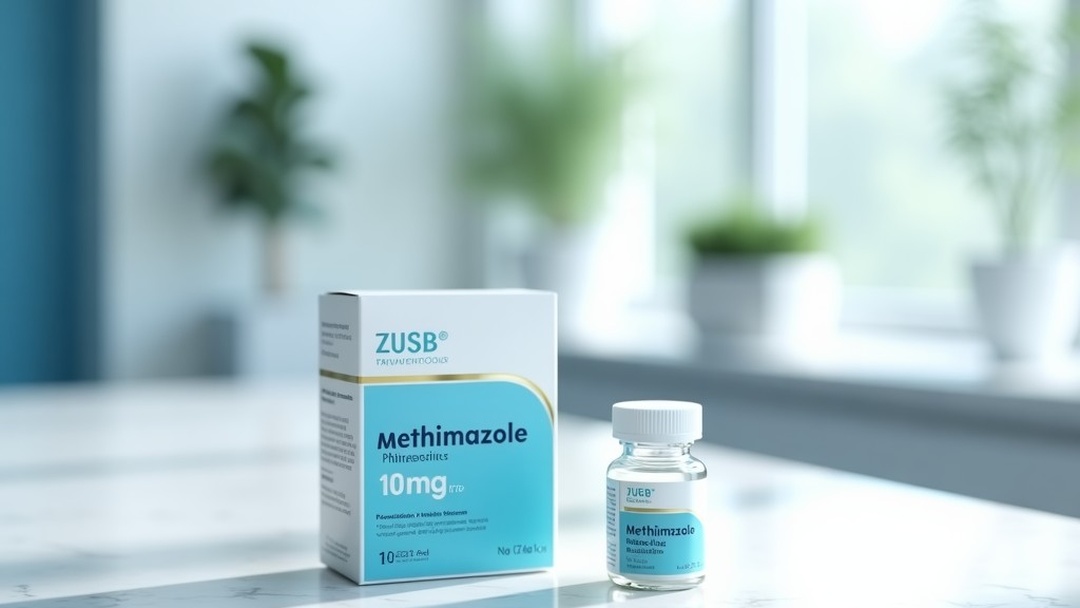
What Is Methimazole (Tapazole)?
Methimazole, marketed under the brand name Tapazole, is the first-line antithyroid medication for hyperthyroidism and Graves’ disease. It belongs to the thionamide class and acts by inhibiting thyroid peroxidase (TPO), blocking the organification of iodine and the coupling of iodotyrosines — thereby preventing the synthesis of thyroxine (T4) and triiodothyronine (T3) without affecting preformed hormone stores.
Mechanism of Action
Methimazole concentrates in the thyroid gland and competitively inhibits TPO at the heme-binding site. It is approximately 10 times more potent than propylthiouracil (PTU) on a molar basis and has a longer intrathyroidal half-life (~12–24 hours), allowing once-daily maintenance dosing. Unlike PTU, methimazole does not significantly inhibit peripheral 5’-deiodinase conversion of T4 to T3.
Approved Indications
- Hyperthyroidism: Graves’ disease, toxic multinodular goiter, toxic adenoma
- Preoperative Preparation: For thyroidectomy to achieve euthyroid state
- Adjunct to Radioiodine Therapy: When I-131 is contraindicated, declined, or unavailable
- Thyroid Storm (Adjunct): Combined with iodine, beta-blockers, corticosteroids
Detailed Dosage Guidelines
| Clinical Scenario | Initial Daily Dose | Frequency | Maintenance Dose | Typical Duration |
|---|---|---|---|---|
| Severe Hyperthyroidism (T3/T4 markedly elevated) | 40–60 mg/day | Divided 3× daily (q8h) | 10–20 mg/day | 12–18 months (up to 24 months for remission) |
| Moderate Hyperthyroidism | 20–40 mg/day | Divided 2× daily (q12h) | 5–15 mg/day | 12–18 months |
| Mild / Subclinical | 10–20 mg/day | Once or twice daily | 5–10 mg/day | 6–12 months |
| Pediatric (≥6 years) | 0.4–0.7 mg/kg/day | Divided 3× daily | 0.2–0.3 mg/kg/day | Adjust by response; monitor growth |
| Preoperative (2–4 weeks before surgery) | 30–60 mg/day + potassium iodide | Divided 3× daily | N/A | Until surgery |
Monitoring: TSH, Free T4, Free T3 every 2–4 weeks initially; then every 2–3 months once stable. CBC with differential at baseline, then every 2–4 weeks for first 3 months (agranulocytosis surveillance).
Side Effects Profile
Common (1–10%)
- Rash, pruritus, urticaria (usually transient, may respond to antihistamines)
- Nausea, vomiting, epigastric discomfort (take with food)
- Arthralgia, myalgia
- Headache, taste disturbance (dysgeusia)
- Alopecia (reversible)
Serious / Rare (<1%) — Requires Immediate Discontinuation
- Agranulocytosis (ANC <500/μL): Incidence ~0.1–0.5% — typically within first 3 months. Check CBC with differential at any fever/sore throat.
- Hepatotoxicity: Cholestatic or hepatocellular — monitor LFTs if symptoms (jaundice, dark urine, RUQ pain)
- Vasculitis: ANCA-positive, cutaneous or systemic
- Lupus-like Syndrome: Arthralgia, fever, positive ANA
- Pancreatitis: Rare but reported
Methimazole vs. Propylthiouracil (PTU) — Detailed Comparison
| Parameter | Methimazole (Tapazole) | Propylthiouracil (PTU) |
|---|---|---|
| Relative Potency | ~10× more potent | Less potent |
| Intrathyroidal Half-life | ~12–24 hours | ~1–2 hours |
| Maintenance Dosing | Once daily preferred | 3× daily required |
| Peripheral T4→T3 Inhibition | Minimal | Yes (5’-deiodinase inhibition) |
| Hepatotoxicity Risk | Lower (~0.1%) | Higher — FDA Boxed Warning |
| Crosses Placenta | Yes — associated with aplasia cutis, choanal atresia | Yes, but preferred in 1st trimester |
| Breastfeeding | Compatible (low milk levels) | Compatible |
| Cost — Generic India (100 tabs) | $15–$25 (10 mg) | $20–$35 (50 mg) |
| Cost — Brand US | $135–$330 (Tapazole) | $180–$440 |
Pregnancy & Lactation Considerations
First Trimester: PTU preferred (methimazole associated with methimazole embryopathy: aplasia cutis, choanal atresia, omphalocele, tracheoesophageal fistula). Switch to methimazole after 1st trimester to minimize PTU hepatotoxicity risk.
Affordable Generic Methimazole from India
Generic Methimazole 10 mg (100 tablets) from Indian manufacturers costs $15–$25 — substantially lower than brand Tapazole in Western markets. Indian facilities follow CDSCO/WHO-GMP standards ensuring bioequivalence.
Browse Methimazole & Thyroid Medications on 984online.com
Monitoring Checklist & Remission Criteria
- ✅ Baseline: CBC with diff, LFTs, TSH, Free T4, Free T3, TSH receptor antibodies (TRAb)
- ✅ Month 1–3: CBC q2 weeks, TSH/FT4/FT3 q4 weeks
- ✅ Month 3–6: CBC monthly, thyroid panel q6–8 weeks
- ✅ Month 6+: CBC q3 months, thyroid panel q3 months
- ✅ Remission Criteria: Normal TSH/FT4/FT3 on ≤5 mg/day methimazole for ≥6 months + negative TRAb
- ✅ Relapse Risk: ~40–60% after discontinuation — higher if TRAb positive, large goiter, or smoking
Patient FAQ
Q: How long until my thyroid levels normalize?
A: Free T4/FT3 typically normalize in 4–8 weeks; TSH may remain suppressed for months due to pituitary recovery lag.
Q: Can I stop methimazole once I feel better?
A: NO. Premature discontinuation causes rebound hyperthyroidism. Complete the full course (12–18 months) even if euthyroid.
Q: What should I do if I develop a fever or sore throat?
A: STOP methimazole immediately and get a CBC with differential TODAY. Agranulocytosis is a medical emergency.
Q: Is methimazole safe during breastfeeding?
A: Yes — minimal transfer to milk; infant exposure <1% of maternal dose. Monitor infant thyroid function if prolonged use.
Important Safety Information
⚠️ Agranulocytosis Warning: Discontinue methimazole immediately if fever, sore throat, mouth ulcers, or signs of infection develop. Obtain stat CBC with differential. Do not rechallenge if confirmed.
⚠️ Hepatotoxicity: Report jaundice, dark urine, clay-colored stools, RUQ pain, or unexplained fatigue promptly.
Disclaimer: This content is for informational purposes only and does not constitute medical advice. Always consult a licensed healthcare provider before starting, stopping, or changing any medication. Prices are approximate ranges based on Indian generic pharmacy pricing and may vary.
References
- Tapazole Prescribing Information. FDA Label.
- Bahn RS et al. “Hyperthyroidism and other causes of thyrotoxicosis.” ATA Guidelines. Thyroid. 2011.
- Ross DS. “Methimazole and propylthiouracil: clinical pharmacology and therapeutic use.” UpToDate.
- Rivkees SA et al. “Propylthiouracil-induced liver failure.” FDA Safety Communication (2009).
- Cooper DS. “Antithyroid drugs.” N Engl J Med. 2005.