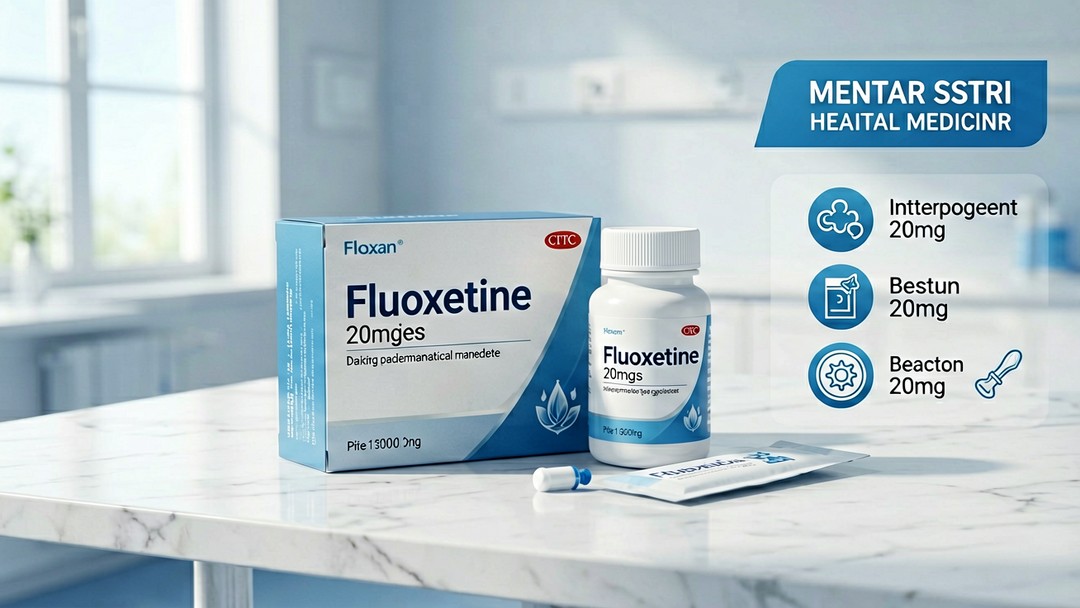
What Is Fluoxetine and How Does It Work?
Fluoxetine, best known by its original brand name Prozac, is a selective serotonin reuptake inhibitor (SSRI) approved by the FDA in December 1987. It was the first SSRI to reach the U.S. market and fundamentally changed the treatment of depression by offering an alternative to tricyclic antidepressants with a far more tolerable side effect profile. Fluoxetine works by blocking the serotonin transporter (SERT) on presynaptic neurons, which raises serotonin levels in the synaptic cleft and enhances serotonergic signaling across mood-regulating circuits in the brain. Unlike many other SSRIs, fluoxetine and its active metabolite norfluoxetine have a remarkably long half-life: roughly 1 to 3 days for fluoxetine and 7 to 15 days for norfluoxetine. This long half-life means steady blood levels are achieved quickly, but it also means that if a patient experiences an adverse reaction, the drug takes weeks to fully clear from the body.
The clinical relevance of this pharmacokinetic profile is significant. Because fluoxetine does not require gradual upward titration to reach steady state as slowly as some alternatives, therapeutic effects may emerge more predictably. At higher doses, fluoxetine also mildly inhibits the reuptake of dopamine, an effect that some researchers believe contributes to its energizing profile and its utility in atypical depression. However, the same properties create a higher risk of drug interactions: fluoxetine and norfluoxetine are potent inhibitors of CYP2D6, and fluoxetine also inhibits CYP2C9 and CYP3A4, which can raise blood levels of many co-administered medications.
FDA-Approved Uses
Fluoxetine carries FDA approval for a broad set of psychiatric indications, which makes it one of the most versatile SSRIs available:
- Major Depressive Disorder (MDD): First-line treatment for moderate to severe depression in adults and in children aged 8 and older, making it one of only two SSRIs approved for pediatric depression.
- Obsessive-Compulsive Disorder (OCD): Approved for adults and children aged 7 and older; fluoxetine is frequently used when OCD symptoms are severe or resistant to initial therapy.
- Panic Disorder: Approved for adults, typically at doses of 10 to 20 mg daily with upward titration.
- Bulimia Nervosa: Approved at 60 mg daily, where it has demonstrated meaningful reductions in binge-purge episodes.
- Premenstrual Dysphoric Disorder (PMDD): Approved as Sarafem at 20 mg daily, either continuously or in the luteal phase.
- Bipolar Depression: Approved as an adjunct to olanzapine, reflecting its use in complex mood disorders.
Off-label but widely supported uses include generalized anxiety disorder, social anxiety disorder, post-traumatic stress disorder, and treatment-resistant depression when combined with atypical antipsychotics.
Fluoxetine vs Other SSRIs: Key Differences
Choosing between SSRIs is rarely about overall efficacy, since large meta-analyses show comparable response rates across the class. The differences that matter most are half-life, withdrawal risk, activation versus sedation, weight effects, and drug interactions.
| Feature | Fluoxetine | Sertraline | Escitalopram | Paroxetine |
| Half-life | 1-3 days (metabolite 7-15 days) | ~26 hours | ~27-32 hours | ~21 hours |
| Withdrawal risk on stopping | Lowest | Moderate | Moderate | Highest |
| Typical effect on energy | Activating | Neutral | Neutral | Sedating |
| Weight gain potential | Low-moderate | Low | Low | Higher |
| CYP2D6 interactions | Strong inhibitor | Mild | Mild | Moderate |
| Approved for pediatric MDD | Yes (8+) | Yes (6+) | No | No |
| Pregnancy data | Extensive | Extensive | Moderate | Moderate |
The practical takeaway: fluoxetine suits patients who miss doses frequently, because its long half-life provides a buffer against withdrawal symptoms, and patients who need an activating agent to combat fatigue and apathy. Patients who are highly sensitive to activation, insomnia, or anxiety in the first weeks may fare better with sertraline or escitalopram.
Dosage and Administration
| Indication | Starting dose | Target dose | Maximum dose |
| Major depressive disorder | 20 mg once daily (morning) | 20-40 mg | 80 mg |
| OCD | 20 mg | 40-60 mg | 80 mg |
| Panic disorder | 10 mg | 20 mg | 60 mg |
| Bulimia nervosa | 60 mg | 60 mg | 60 mg |
| PMDD | 20 mg (continuous or luteal-phase) | 20 mg | 60 mg |
Fluoxetine is taken once daily, usually in the morning, because of its activating profile; evening dosing can worsen insomnia. It can be taken with or without food, and the capsule formulation can be opened and sprinkled on applesauce for patients who cannot swallow capsules. Because of the long half-life, dose changes should be made no more frequently than every 1 to 2 weeks, and discontinuation generally does not require the slow tapering needed with shorter-acting SSRIs, although gradual reduction is still recommended to monitor for relapse.
Clinical Evidence
The evidence base for fluoxetine is among the largest in psychopharmacology. In the landmark STAR*D trial, which enrolled more than 4,000 outpatients with nonpsychotic major depressive disorder, citalopram (a close relative) achieved remission in about 28 to 33 percent of patients at step one, and response rates across SSRIs have consistently ranged from 50 to 70 percent in acute-phase trials. A 2018 network meta-analysis in The Lancet comparing 21 antidepressants found fluoxetine significantly more effective than placebo and broadly comparable to sertraline and escitalopram, with a more favorable acceptability profile than amitriptyline, paroxetine, and mirtazapine.
In OCD, randomized trials show fluoxetine 40 to 60 mg daily produces clinically meaningful reductions in Yale-Brown Obsessive Compulsive Scale scores over 10 to 13 weeks. In panic disorder, fixed-dose trials demonstrate superiority over placebo from week 3 onward. Long-term data from the National Institute of Mental Health and pooled relapse-prevention studies indicate that continuing fluoxetine for 6 to 12 months after remission reduces relapse risk by roughly 50 to 70 percent compared with placebo.
Side Effects and Safety
The most common adverse effects during the first 2 to 4 weeks are nausea, headache, insomnia, nervousness, diarrhea, and decreased appetite. Most are transient. Sexual dysfunction, including delayed ejaculation and reduced libido, affects an estimated 25 to 40 percent of patients and is the most common reason for switching agents. Fluoxetine is associated with a small but real increase in suicidal ideation in patients under 25 during early treatment, which is why close monitoring in the first weeks is mandatory. Serotonin syndrome is rare but can be life-threatening when fluoxetine is combined with MAO inhibitors, triptans, tramadol, or St. John’s wort; a 5-week washout is required after stopping fluoxetine before starting an MAOI. Because of CYP2D6 inhibition, fluoxetine can raise levels of many beta-blockers, antipsychotics, and type 1C antiarrhythmics, so a medication review is essential before starting therapy.
Generic Fluoxetine: Quality, Cost, and Accessibility
Fluoxetine has been available as a generic since 2001, and generic fluoxetine is bioequivalent to the original brand by FDA standards, meaning the same active ingredient, strength, and clinical effect at a fraction of the cost. For patients paying out of pocket, generic pricing varies enormously by market.
In the United States, a 30-tablet supply of generic fluoxetine 20 mg typically retails in the range of $18 to $45 depending on pharmacy and discount programs, while the original brand formulation can cost $270 to $500 for the same supply when not covered by insurance. In India and other regulated generic markets, the same 30-tablet supply is typically available for approximately $4 to $11, and a 100-tablet pack of many antidepressants from established Indian manufacturers commonly falls in the $35 to $50 range. These price differences drive the growing international demand for affordable generic antidepressants; for patients without insurance or with high deductibles, sourcing from quality-assured Indian suppliers can cut monthly treatment costs by 70 to 90 percent.
If you are exploring cost-effective treatment options, our antidepressant product range includes quality-assured generic fluoxetine and related SSRIs with transparent pricing.
Decision Guide: Is Fluoxetine Right for You?
- Choose fluoxetine if: you need an activating antidepressant, you have struggled with missed doses and withdrawal symptoms on shorter-acting SSRIs, you are treating OCD or bulimia, or you are looking for the most extensively studied SSRI with pediatric approval.
- Consider an alternative if: you are prone to insomnia or agitation, you take multiple medications metabolized by CYP2D6, you are planning pregnancy (although fluoxetine has extensive pregnancy data, paroxetine is generally avoided and escitalopram or sertraline are often preferred), or you had a poor response to a previous SSRI trial.
- Always: start at the lowest effective dose, monitor closely in weeks 1 to 4, and never stop abruptly without medical guidance, even though fluoxetine’s long half-life makes withdrawal milder than with other SSRIs.
Frequently Asked Questions
Q: How long does fluoxetine take to work? A: Initial improvements in sleep, appetite, and energy often appear within 1 to 2 weeks, but the full antidepressant and anti-OCD effect typically requires 4 to 8 weeks at a therapeutic dose. Some patients need 8 to 12 weeks before judging whether the drug is effective for them.
Q: Can I take fluoxetine in the evening? A: It is usually taken in the morning because of its activating effect. If sedation occurs instead, evening dosing can be considered, but if insomnia is the problem, the dose should be moved earlier in the day rather than later.
Q: Is weight gain common with fluoxetine? A: In short-term trials fluoxetine is often associated with slight weight loss; long-term use is linked to modest weight gain in some patients, though generally less than with paroxetine or mirtazapine. Individual responses vary considerably.
Q: What is the difference between fluoxetine and Prozac? A: None in terms of active ingredient. Prozac was the original brand name; fluoxetine is the generic name. Generic fluoxetine is bioequivalent and substantially less expensive.
Q: Is fluoxetine safe during pregnancy? A: Fluoxetine crosses the placenta and has been associated with a small increase in the risk of certain neonatal complications when used in late pregnancy. However, untreated depression also carries risks. Decisions should be made with an obstetrician and psychiatrist weighing both sides; sertraline is often preferred in pregnancy, but fluoxetine is not absolutely contraindicated.
Q: What should I avoid while taking fluoxetine? A: Avoid MAO inhibitors (a 5-week gap is required), alcohol, and high doses of NSAIDs or anticoagulants without medical advice due to a small bleeding risk. Tell your doctor about all supplements, especially St. John’s wort and tryptophan, which can trigger serotonin syndrome.
References
- U.S. Food and Drug Administration. Prozac (fluoxetine hydrochloride) Prescribing Information. FDA Label.
- Cipriani A, Furukawa TA, Salanti G, et al. Comparative efficacy and acceptability of 21 antidepressant drugs for the acute treatment of adults with major depressive disorder: a systematic review and network meta-analysis. The Lancet. 2018;391(10128):1357-1366.
- Rush AJ, Trivedi MH, Wisniewski SR, et al. Acute and longer-term outcomes in depressed outpatients requiring one or several treatment steps: a STAR*D report. American Journal of Psychiatry. 2006;163(11):1905-1917.
- American Psychiatric Association. Practice Guideline for the Treatment of Patients With Major Depressive Disorder. 3rd ed. 2010.
- National Institute of Mental Health. Depression: What You Need to Know. NIMH Publication.
- Bloch MH, McGuire J, Landeros-Weisenberger A, et al. Meta-analysis of the dose-response relationship of SSRI in obsessive-compulsive disorder. Molecular Psychiatry. 2010;15(8):850-855.
Medical Disclaimer
This article is for informational purposes only and does not constitute medical advice. Fluoxetine is a prescription medicine; do not start, stop, or change your dose without consulting a qualified healthcare provider. Depression and OCD are serious conditions that require professional diagnosis and monitoring. Medication prices vary over time, by pharmacy, and by country; all figures above are approximate ranges for guidance only.