
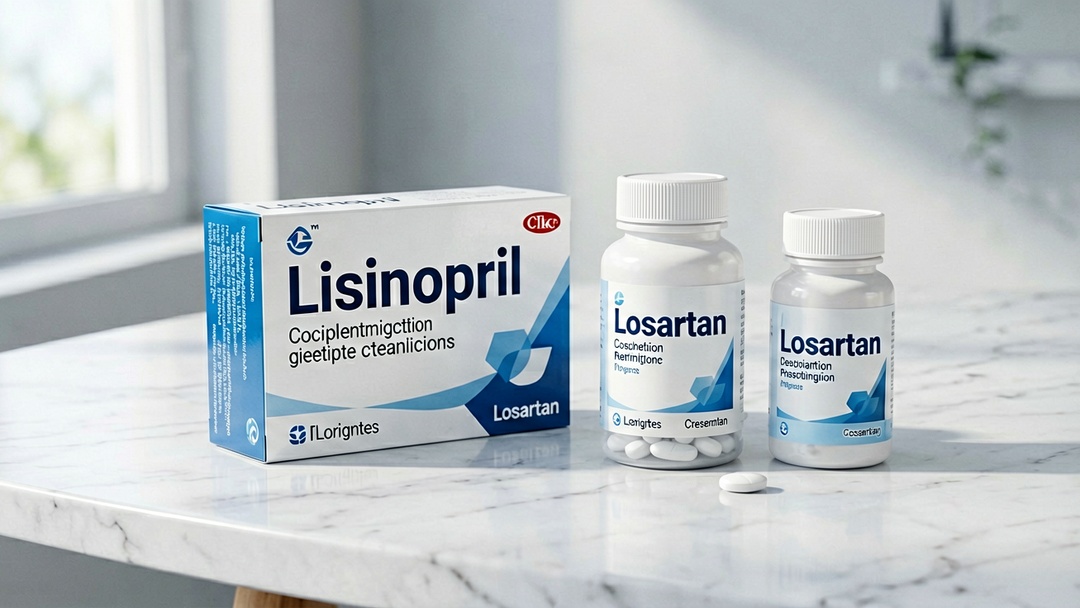
Lisinopril vs Losartan for High Blood Pressure: Which ACE Inhibitor or ARB Is Right for You?
What Are Lisinopril and Losartan?
Lisinopril and losartan are two of the most commonly prescribed medications for hypertension (high blood pressure) worldwide. They belong to different drug classes—ACE inhibitors and angiotensin II receptor blockers (ARBs)—but target the same physiological pathway: the renin-angiotensin-aldosterone system (RAAS). With millions of patients using these therapies daily, understanding their differences is critical for optimizing blood pressure management.
Lisinopril (brand name Prinivil, Zestril) is an angiotensin-converting enzyme (ACE) inhibitor approved by the FDA in 2014. Losartan (brand name Cozaar, Hyzaar) is an angiotensin II receptor blocker (ARB) approved in 1995. Both medications are available as affordable generic options and are recommended by major hypertension guidelines as first-line therapy.
Mechanism of Action
Lisinopril (ACE Inhibitor)
Lisinopril works by inhibiting the angiotensin-converting enzyme (ACE) that converts angiotensin I to angiotensin II. Since angiotensin II is a potent vasoconstrictor, reducing its production leads to: vasodilation of arterioles and veins; decreased aldosterone secretion (reducing sodium and water retention); reduced cardiac preload and afterload; and decreased systemic vascular resistance. By blocking ACE, lisinopril also prevents the breakdown of bradykinin, a vasodilatory peptide, which contributes to its blood-pressure-lowering effects but also causes its characteristic side effect of dry cough.
Losartan (ARB)
Losartan works downstream from lisinopril by selectively blocking the angiotensin II type 1 (AT1) receptor. This prevents angiotensin II from binding to its receptor site regardless of how much angiotensin II is circulating. Losartan allows the counter-regulatory AT2 receptor to remain unopposed, producing additional vasodilation through activation of the kallikrein-kinin system. Unlike lisinopril, losartan does not affect bradykinin metabolism, which explains its lower incidence of cough as a side effect.
Dosage Comparison
| Parameter | Lisinopril | Losartan |
|---|---|---|
| Starting Dose (Hypertension) | 5-10 mg once daily | 25-50 mg once daily |
| Usual Maintenance Dose | 10-40 mg/day | 50-100 mg/day |
| Maximum Dose | 80 mg/day | 100 mg/day |
| Heart Failure Dose | 5-40 mg/day | 50 mg/day (starting) |
| Onset of Action | 1-2 hours | 2-6 hours |
| Peak Effect | 6-8 hours | 3-6 weeks (full BP control) |
| Half-Life | 12 hours (accumulation phase longer) | ~2 hours (active metabolite ~6-9 hours) |
| Duration of Action | 24 hours | 24 hours |
| Dosing Frequency | Once daily | Once or twice daily |
Efficacy Comparison: Blood Pressure Reduction
| Parameter | Lisinopril (20 mg) | Losartan (50 mg) |
|---|---|---|
| Systolic BP Reduction (average) | 12-18 mmHg | 10-16 mmHg |
| Diastolic BP Reduction (average) | 8-12 mmHg | 6-10 mmHg |
| Response Rate (BP control) | 50-70% as monotherapy | 45-65% as monotherapy |
| Combination with HCTZ | Additive 8-10 mmHg SBP reduction | Additive 8-10 mmHg SBP reduction |
| Time to Full Effect | 2-4 weeks | 3-6 weeks |
Meta-analyses comparing ACE inhibitors and ARBs head-to-head suggest that both classes produce similar blood pressure reductions, with lisinopril having a marginally greater effect. A 2017 systematic review of 106 trials found that ACE inhibitors reduce systolic BP by an average of 14 mmHg and diastolic by 9 mmHg, compared to ARBs reducing systolic by 12 mmHg and diastolic by 8 mmHg. Both classes have similar long-term cardiovascular protection outcomes.
Cardiovascular and Renal Protection
| Outcome | Lisinopril (ACE Inhibitor) | Losartan (ARB) |
|---|---|---|
| Mortality Reduction (Heart Failure) | ✅ Proven (SOLVD, CONSENSUS) | ✅ Proven (ELITE II, HEAAL) |
| Post-AMI Survival Benefit | ✅ Strong evidence (GISSI-3, SAVE) | ✅ Demonstrated (OPTIMAAL, VALIANT) |
| Stroke Reduction | ✅ Proven | ✅ Proven (LIFE study) |
| Diabetic Nephropathy | ✅ Proven (RENAAL, IDNT) | ✅ Proven (RENAAL, IDNT) |
| Reduction in New-Onset Diabetes | ⚠️ Modest benefit | ✅ Better proven (LIFE, ALPINE) |
| Left Ventricular Hypertrophy Reversal | ✅ Well-documented | ✅ Well-documented |
Side Effects Comparison
| Side Effect | Lisinopril (ACE) | Losartan (ARB) |
|---|---|---|
| Dry Cough | 10-20% (characteristic) | 1-3% (much less common) |
| Angioedema | 0.1-0.7% (rare but serious) | Extremely rare |
| Hyperkalemia | 2-10% | 2-8% |
| Acute Kidney Injury | Risk in dehydration/NSAID use | Risk in volume depletion |
| Hypotension (First Dose) | Moderate risk | Lower risk |
| Dizziness | 5-8% | 3-5% |
| Fatigue | 3-5% | 2-4% |
| Fetal Toxicity | ⚠️ Black box warning (2nd/3rd trimester) | ⚠️ Black box warning (2nd/3rd trimester) |
The most significant clinical difference in side effect profiles is the incidence of dry cough. Lisinopril-induced cough is caused by bradykinin accumulation and can affect 10-20% of patients, often leading to discontinuation. ARBs like losartan are the preferred alternative for patients who cannot tolerate ACE inhibitors due to cough.
Drug Interactions
Lisinopril-specific: NSAIDs (reduce efficacy, increase renal risk), potassium supplements (hyperkalemia risk), lithium (increased lithium levels), loop and thiazide diuretics (additive hypotensive effect, electrolyte monitoring needed).
Losartan-specific: Rifampin (reduces losartan efficacy), fluconazole (increases losartan levels), NSAIDs (reduced ARB efficacy, increased renal risk). Losartan’s active metabolite is primarily excreted via biliary pathways, with renal clearance being less important for elimination than for ACE inhibitors.
Both: Aliskiren is contraindicated in patients with diabetes or moderate-to-severe renal impairment when combined with either ACE inhibitors or ARBs, due to increased risk of hyperkalemia, hypotension, and renal impairment.
Clinical Trial Evidence
The landmark SOLVD trials demonstrated that ACE inhibitors, including lisinopril, reduce mortality by 16% in heart failure patients and prevent progression from asymptomatic to symptomatic left ventricular dysfunction. The GISSI-3 trial specifically confirmed that lisinopril reduces mortality by 11% in patients with acute myocardial infarction.
For losartan, the LIFE study showed that losartan reduced cardiovascular mortality and stroke more effectively than atenolol in patients with hypertension and left ventricular hypertrophy, despite similar blood pressure reductions in both groups. The RENAAL trial established losartan as nephroprotective in patients with type 2 diabetes and nephropathy.
Pricing: India Generic vs. US Brand
| Product | Indian Generic Price (30 days) | US Brand/Retail Price (30 days) |
|---|---|---|
| Lisinopril 10 mg (generic, 30 tablets) | $3-$7 | $14-$36 |
| Lisinopril 20 mg (generic, 30 tablets) | $4-$9 | $18-$45 |
| Losartan 50 mg (generic, 30 tablets) | $5-$11 | $18-$54 |
| Losartan 100 mg (generic, 30 tablets) | $7-$14 | $27-$72 |
| Cozaar (Losartan brand US) | N/A | $108-$270 |
| Zestril (Lisinopril brand US) | N/A | $90-$225 |
Affordable Generic Options: Both lisinopril and losartan are available as generic medications from Indian manufacturers at substantially lower prices. Major Indian pharmaceutical companies like Sun Pharma, Cipla, Aurobindo Pharma, and Lupin produce these medications under WHO-GMP certified facilities. Browse our blood pressure medications at 984online.com for quality-assured generics at affordable prices.
FAQ: Lisinopril vs Losartan
Which is better: lisinopril or losartan?
Both are highly effective for hypertension, with slight differences. Lisinopril may produce marginally greater blood pressure reduction, but losartan has a lower side effect profile (less cough and angioedema). The choice often depends on patient tolerance and individual response.
Can I switch from lisinopril to losartan?
Yes, this is a common clinical practice, particularly when patient develops a dry cough from lisinopril. There is no direct equivalent dosing conversion, but typical switching strategy involves starting losartan 50 mg when transitioning from lisinopril 10-20 mg, with gradual up-titration based on BP response.
Why does lisinopril cause a cough?
The cough is caused by accumulation of bradykinin, which is normally broken down by ACE. ACE inhibitors like lisinopril block this breakdown, leading to increased bradykinin levels that irritate the respiratory system and trigger a hacking, non-productive cough.
Which is safer for the kidneys?
Both are nephroprotective in patients with diabetic nephropathy and proteinuria. The choice between them for renal protection depends more on the specific condition being treated than the class, as both ACE inhibitors and ARBs have evidence supporting renoprotective effects.
Do lisinopril and losartan protect against heart attack and stroke?
Yes, both have proven cardiovascular benefits including reduced risk of myocardial infarction, stroke, and cardiovascular death in patients with hypertension, heart failure, or post-myocardial infarction.
What is the monthly cost difference between Indian generic and US brand?
Indian generic lisinopril costs $3-$9 per month for standard doses, compared to US brand versions at $90-$225 per month. Losartan Indian generic costs $4-$14 per month, compared to US brand versions at $108-$270 per month.
Which is better for preventing stroke in elderly patients?
Both have demonstrated stroke reduction benefits. The LIFE study showed losartan superior to atenolol in reducing stroke risk. ACE inhibitors also have strong positive clinical data for stroke prevention in hypertension management.
Safety and Precautions
- Pregnancy: Both lisinopril and losartan carry FDA Black Box Warnings for fetal toxicity when used during the second and third trimesters. These medications should be discontinued as soon as pregnancy is detected.
- Renal Artery Stenosis: Both medications can cause azotemia and acute kidney injury in patients with bilateral renal artery stenosis or stenosis of a solitary kidney’s artery.
- Aortic Stenosis: ACE inhibitors like lisinopril should be used with caution in patients with aortic stenosis complicated by reduced coronary perfusion.
- Volume Depletion: Patients who are volume- or sodium-depleted (due to diuretics, diarrhea, or vomiting) are at increased risk for first-dose hypotension. Consider starting at lower doses and gradually titrating.
- Monitoring: Regular monitoring of blood pressure, renal function (creatinine, BUN), and serum potassium is recommended for both medications at baseline and during dose adjustments.
Which Should You Choose?
If you are starting treatment for hypertension, both lisinopril and losartan are excellent evidence-based choices. Generally, ACE inhibitors like lisinopril are considered first-line due to more extensive long-term outcome data. However, if you have pre-existing chronic cough, are of African descent (higher risk of angioedema with ACE inhibitors), or have a history of particularly troublesome cough, losartan may be the better initial choice. For patients requiring maximum renin-angiotensin system blockade with minimal side effects, ARBs are preferred. The most important factor is consistent daily adherence, as both medications require sustained use to achieve their full blood pressure-lowering and cardiovascular protective benefits.
References
- Whelton PK, et al. “2017 ACC/AHA Hypertension Guideline.” Journal of the American College of Cardiology. 2018;71(19):e127-e248.
- Dahlöf B, et al. “Cardiovascular morbidity and mortality in the Losartan Intervention For Endpoint reduction in hypertension study (LIFE).” Lancet. 2002;359(9311):995-1003.
- SOLVD Investigators. “Effect of enalapril on survival in patients with reduced left ventricular ejection fractions and congestive heart failure.” NEJM. 1991;325(5):293-302.
- Brenner BM, et al. “Effects of losartan on renal and cardiovascular outcomes in patients with type 2 diabetes and nephropathy.” NEJM. 2001;345(12):861-869. (RENAULT)
- FDA Prescribing Information: Prinivil (lisinopril). Merck Sharp & Dohme Corp, 2021.
- FDA Prescribing Information: Cozaar (losartan potassium). Merck & Co, 2022.
- Yusuf S, et al. “Telmisartan, ramipril, or both in patients at high risk for vascular events.” NEJM. 2008;358(15):1547-1559. (ONTARGET)
- Williams B, et al. “2018 ESC/ESH Guidelines for the management of arterial hypertension.” European Heart Journal. 2018;39(33):3021-3104.
Medical Disclaimer: This information is provided for educational purposes only. It does not constitute medical advice and should not replace consultation with a qualified healthcare professional. All prices shown are ±10% ranges to reflect typical market variation. Always consult your doctor before starting, changing, or stopping any blood pressure medication.