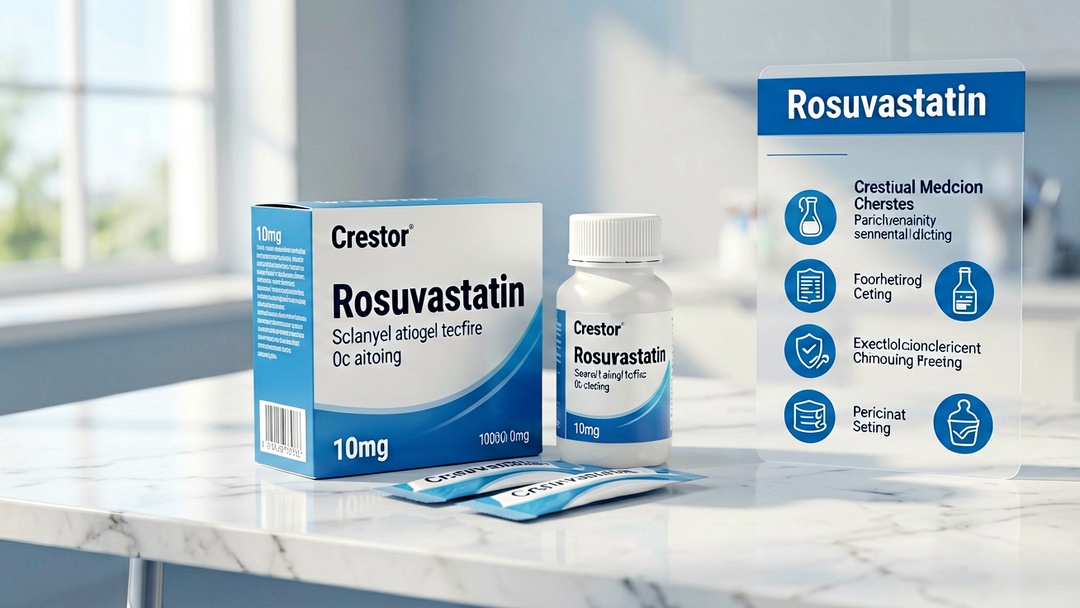
Rosuvastatin, marketed under the brand name Crestor, belongs to the statin class of lipid-lowering medications and is widely regarded as one of the most potent options available for managing hypercholesterolemia and reducing cardiovascular risk. Since its FDA approval in 2003, rosuvastatin has become a cornerstone of preventive cardiology, prescribed to millions of patients worldwide for both primary and secondary prevention of atherosclerotic cardiovascular disease (ASCVD). This comprehensive guide examines rosuvastatin’s pharmacology, clinical evidence, dosing strategies, safety considerations, and cost-effective generic alternatives.
What Is Rosuvastatin and How Does It Work?
Rosuvastatin is a synthetic lipid-lowering agent that functions as a selective and competitive inhibitor of HMG-CoA reductase, the rate-limiting enzyme in the mevalonate pathway responsible for hepatic cholesterol biosynthesis. By inhibiting this enzyme, rosuvastatin reduces intracellular cholesterol levels within hepatocytes, which triggers a compensatory upregulation of low-density lipoprotein (LDL) receptors on the liver cell surface. These receptors then clear circulating LDL cholesterol (LDL-C) from the bloodstream, resulting in significant reductions in plasma LDL-C levels.
What distinguishes rosuvastatin from other statins is its exceptional potency. At equivalent milligram doses, rosuvastatin produces approximately 2-fold greater LDL-C reduction compared to atorvastatin, 4-fold greater than simvastatin, and 8-fold greater than pravastatin. This high potency is attributed to rosuvastatin’s unique molecular structure, which includes a polar methane sulfonamide group that enhances HMG-CoA reductase binding affinity and confers hepatic selectivity through active transport via organic anion transporting polypeptides (OATP1B1).
FDA-Approved Indications
Rosuvastatin has received FDA approval for several cardiovascular indications:
- Primary hyperlipidemia and mixed dyslipidemia: Reduction of elevated total cholesterol, LDL-C, apoB, and triglycerides while increasing HDL-C.
- Homozygous familial hypercholesterolemia (HoFH): As an adjunct to other lipid-lowering therapies or when such treatments are unavailable.
- Primary prevention of ASCVD: In adults without clinically evident coronary heart disease but with multiple risk factors such as elevated hs-CRP, hypertension, smoking, or family history.
- Secondary prevention of ASCVD: In patients with established coronary artery disease, cerebrovascular disease, or peripheral arterial disease.
- Slowing progression of atherosclerosis: Demonstrated through imaging studies showing reduced carotid intima-media thickness.
Rosuvastatin Dosage Forms and Administration
Rosuvastatin is available in multiple dosage strengths to facilitate individualized treatment based on baseline LDL-C levels, treatment goals, and patient tolerance.
| Indication | Starting Dose | Usual Maintenance Dose | Maximum Dose |
|---|---|---|---|
| Primary hyperlipidemia | 5-10 mg once daily | 10-20 mg once daily | 40 mg once daily |
| Mixed dyslipidemia | 5-10 mg once daily | 10-20 mg once daily | 40 mg once daily |
| HoFH | 20 mg once daily | 20-40 mg once daily | 40 mg once daily |
| Asian patients | 5 mg once daily | 5-20 mg once daily | 20 mg once daily |
Rosuvastatin can be administered at any time of day, with or without food. Evening administration is commonly recommended because cholesterol synthesis peaks during nocturnal hours, aligning with the drug’s mechanism of action. The 40 mg dose is reserved for patients who have not achieved goal LDL-C levels on 20 mg and are at high cardiovascular risk.
Lipid-Lowering Efficacy: Rosuvastatin vs. Other Statins
Rosuvastatin consistently demonstrates superior LDL-C reduction compared to other statins at equivalent or even lower milligram doses. The STELLAR trial, a landmark comparative study, provided head-to-head efficacy data across the statin class.
| Statin | Dose | LDL-C Reduction | HDL-C Increase | Triglyceride Reduction |
|---|---|---|---|---|
| Rosuvastatin | 10 mg | 42-46% | 8-10% | 18-22% |
| Rosuvastatin | 20 mg | 48-52% | 9-11% | 22-26% |
| Rosuvastatin | 40 mg | 54-58% | 10-12% | 26-30% |
| Atorvastatin | 20 mg | 38-42% | 5-7% | 20-24% |
| Atorvastatin | 40 mg | 44-48% | 5-8% | 24-28% |
| Simvastatin | 40 mg | 32-36% | 6-8% | 14-18% |
| Pravastatin | 40 mg | 28-32% | 4-6% | 10-14% |
Clinical Outcomes Evidence
The JUPITER trial (Justification for the Use of Statins in Prevention: an Intervention Trial Evaluating Rosuvastatin) enrolled 17,802 adults with LDL-C levels below 130 mg/dL but elevated high-sensitivity C-reactive protein (hs-CRP) of 2.0 mg/L or higher. The trial was stopped early after a median follow-up of 1.9 years due to overwhelming benefit. Rosuvastatin 20 mg reduced the composite primary endpoint (myocardial infarction, stroke, revascularization, hospitalization for unstable angina, or cardiovascular death) by 44% compared to placebo. These results expanded the role of statin therapy to primary prevention in patients with elevated inflammatory markers.
The CORONA trial evaluated rosuvastatin 10 mg in 5,011 patients aged 60 years and older with systolic heart failure of ischemic etiology. While the primary composite endpoint did not reach statistical significance, rosuvastatin significantly reduced the secondary endpoint of atherosclerotic events including non-fatal MI and non-fatal stroke. The AURORA trial in hemodialysis patients showed reductions in LDL-C and hs-CRP but did not achieve statistical significance for the primary cardiovascular composite endpoint, highlighting the complex pathophysiology of cardiovascular disease in end-stage renal disease.
Safety Profile and Side Effects
Rosuvastatin is generally well-tolerated, with a safety profile comparable to other statins. The most common adverse effects include myalgia (muscle pain without elevated creatine kinase, 3-5%), arthralgia (2-3%), headache (2-4%), nausea (2-3%), constipation (2-3%), and abdominal pain (1-2%). The risk of serious adverse events such as rhabdomyolysis is low, occurring in approximately 1 per 10,000 patient-years with standard dosing.
Rosuvastatin has a notable advantage in terms of drug interaction potential. Unlike atorvastatin, simvastatin, and lovastatin, rosuvastatin is not significantly metabolized by CYP3A4, reducing the risk of interactions with commonly prescribed medications that inhibit this enzyme. However, rosuvastatin is subject to interactions with OATP1B1 and BCRP transporter inhibitors. Dose adjustment is recommended when co-administering with gemfibrozil, cyclosporine, certain protease inhibitors, and select hepatitis C antiviral regimens.
Cost Comparison: Brand vs. Generic Rosuvastatin
The cost of rosuvastatin varies considerably between the brand-name Crestor and generic alternatives. In the United States, brand Crestor 10 mg tablets typically cost $270-$360 for a 30-tablet supply (approximately $9-$12 per tablet). The 20 mg dose costs approximately $300-$390 per month, while the 40 mg dose ranges from $330-$420 per month.
Generic rosuvastatin, manufactured by Indian pharmaceutical companies such as AstraZeneca (the same manufacturer producing Crestor for non-U.S. markets) and other WHO-GMP certified facilities, is available at a significantly lower cost. A 30-tablet supply of generic rosuvastatin 10 mg typically costs $8-$15 (approximately $0.27-$0.50 per tablet), the 20 mg dose costs $12-$22, and the 40 mg dose costs $18-$32.
For patients exploring affordable generic cardiovascular medications, the potential savings are transformative. A year’s supply of generic rosuvastatin 20 mg (365 tablets) can cost $145-$268 through international pharmacy sources, compared to $3,600-$4,680 for the brand-name equivalent in U.S. retail pharmacies.
| Product | Strength | 30-Tablet Price | Cost Per Tablet |
|---|---|---|---|
| Brand Crestor (USA retail) | 10 mg | $270-$360 | $9-$12 |
| Brand Crestor (USA retail) | 20 mg | $300-$390 | $10-$13 |
| Generic Rosuvastatin (Indian mfr.) | 10 mg | $8-$15 | $0.27-$0.50 |
| Generic Rosuvastatin (Indian mfr.) | 20 mg | $12-$22 | $0.40-$0.73 |
| Generic Rosuvastatin (Indian mfr.) | 40 mg | $18-$32 | $0.60-$1.07 |
Special Populations and Monitoring
Asian patients demonstrate approximately 2-fold higher rosuvastatin exposure compared to Caucasian populations, necessitating lower starting doses (5 mg) and a maximum dose of 20 mg. Patients with severe renal impairment (creatinine clearance below 30 mL/min) should not receive doses above 10 mg. Rosuvastatin is contraindicated in patients with active liver disease or unexplained persistent elevations of serum transaminases exceeding 3 times the upper limit of normal.
Routine monitoring should include baseline and periodic liver function tests and creatine kinase levels, particularly in patients at increased risk of myopathy. Lipid profiles should be assessed 2-4 weeks after starting therapy and with each dose adjustment.
Frequently Asked Questions
1. How long does rosuvastatin take to lower cholesterol?
Rosuvastatin begins reducing LDL-C levels within 1 week of starting therapy, with maximal effects observed after 2-4 weeks of consistent dosing.
2. Is rosuvastatin stronger than atorvastatin?
Yes, milligram for milligram, rosuvastatin is approximately 2 times more potent than atorvastatin at reducing LDL-C. Rosuvastatin 10 mg produces comparable LDL-C reduction to atorvastatin 20-30 mg.
3. Can rosuvastatin be taken with blood pressure medications?
Yes, rosuvastatin has minimal drug interactions with common antihypertensives. However, it should not be taken with gemfibrozil due to increased myopathy risk.
4. Does rosuvastatin cause weight gain?
Weight gain is not a recognized side effect of rosuvastatin. Statin therapy has not been associated with significant changes in body weight in clinical trials.
5. Can generic rosuvastatin be split?
Rosuvastatin tablets are film-coated and should generally be swallowed whole. Scored tablets may be split with caution, but it is advisable to use the appropriate prescribed strength.
Conclusion
Rosuvastatin remains a first-line therapeutic option for managing hypercholesterolemia and reducing cardiovascular risk, distinguished by its superior potency, favorable drug interaction profile, and robust clinical evidence from landmark trials including JUPITER. The availability of affordable generic alternatives has substantially improved access for patients worldwide. As with all statins, individual risk assessment, appropriate dosing, and regular monitoring are essential for optimizing outcomes and minimizing adverse effects.
References
- Ridker PM, et al. Rosuvastatin to prevent vascular events in men and women with elevated C-reactive protein. N Engl J Med. 2008;359(21):2195-2207.
- Jones PH, et al. Comparison of the efficacy and safety of rosuvastatin versus atorvastatin, simvastatin, and pravastatin (STELLAR trial). Am J Cardiol. 2003;92(2):152-160.
- FDA Prescribing Information: Crestor (rosuvastatin calcium) tablets. AstraZeneca. Revised 2022.
- Kjekshus J, et al. Rosuvastatin in older patients with systolic heart failure (CORONA). N Engl J Med. 2007;357(22):2248-2261.
- Grundy SM, et al. 2018 AHA/ACC guideline on management of blood cholesterol. Circulation. 2019;139(25):e1082-e1143.
- Mach F, et al. 2019 ESC/EAS guidelines for the management of dyslipidaemias. Eur Heart J. 2020;41(1):111-188.
Medical Disclaimer: This article is for informational purposes only and does not constitute medical advice. Always consult a licensed healthcare provider before starting any new medication. Pricing information reflects approximate market ranges and may vary based on location, insurance coverage, pharmacy, and time of purchase.